
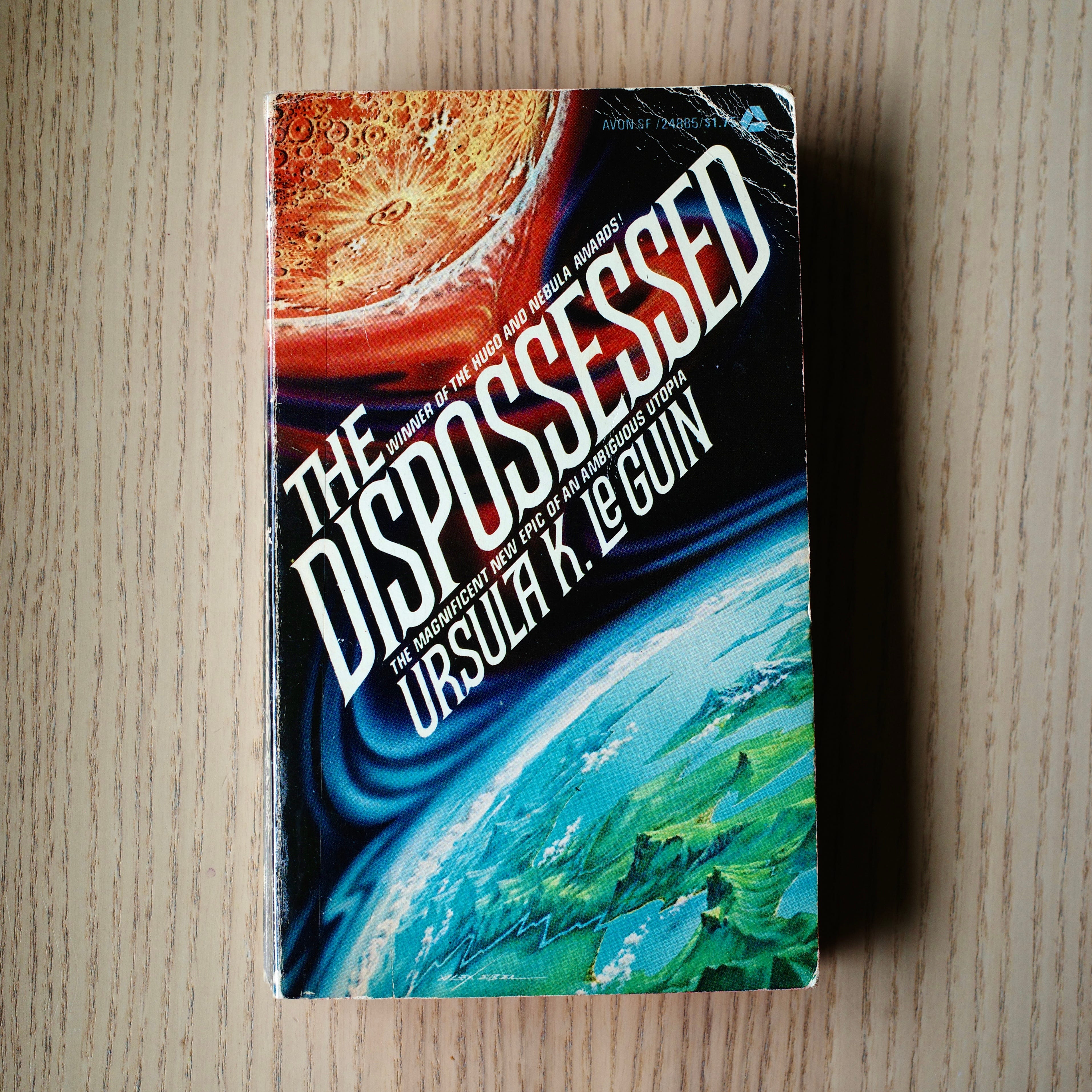
I. 2019
I read The Dispossessed for the first time in early spring of 2019. I was in my late 20s and living in West Philadelphia.
It’s a novel about an anarchist utopia, built by exiled revolutionaries seven generations ago on the habitable moon (Anarres) of an Earthlike planet (Urras). It’s a world without coercion or ownership, without a king, president, or party. People work in collectives, eat in cafeterias, and sleep in dormitories. It is a better world than most of us are capable of imagining, but because this is Ursula K. Le Guin, it isn’t a cartoonish fantasy. She gives Anarres flaws, texture, personality, and, perhaps most daringly, subtlety.
The story follows Shevek, an Anarresti physicist. Shevek finds it difficult to do his work because a multi-generational taboo against communication with Urras prevents him from interacting with the leading minds in physics. To overcome this, he becomes the first Anarresti to visit Urras since the separation. Whereas Anarres is a bold vision of a very different way of life, Urras is much more like our own world, and now we see it through the eyes of this alien visitor: there is so much coercion and inequality that we have come to seem as normal, invisible, or unavoidable, but none of it seems that way to Shevek. Quite without intending to, Shevek’s mere presence lights the sparks of a new revolution.
2019 was a ripe moment for me to encounter this particular story. The book had sat on my shelf for years, but it seemed like I had held off until I was maximally open to its ideas. West Philadelphia is itself quite anarchist. It’s a place where people argue about specific strains and sects of communitarian thinking. I heard more than one person say about The Dispossessed “If I have an ideology, it’s that book.”
Despite the fact that some of my best friends were anarchists of one flavor or another, I had never considered myself one. Yet when I read the novel, I found myself ensnared by Le Guin’s vision. The ideas felt so simple and workable. It felt like common sense. Perhaps this was because West Philly modeled so many of them already. I knew a lot of people who lived in big, leaking houses with six other roommates. They were idealists who packed these buildings with instruments, bicycles, cats, and weaving looms. Many of these people were graduates of prestigious liberal arts colleges and former co-op residents. And what was Anarres if not an enormous university campus?
And that, basically, is how I understood The Dispossessed the first time I read it, as a blueprint for a better world. The flaws in this “ambiguous utopia” were there to make a story and to smooth the way for our suspension of disbelief. They were the ticket for entry to the future. This world was beautiful, and we would choose it if we could.
II. 2020-2025
In the years that followed my first reading, I thought of the book from time to time. I would be in a conversation about politics or Science Fiction, and I would think of The Dispossessed. Every time I reached for that idealistic vision, I remembered the complicating details. Where once I had mostly seen the bold dream of Anarres, I came to think more and more about its flaws and limitations.
Everyone on the entire planet is descended from the original revolutionaries. They all come to this place for the express and common goal of building a new world. They rewrote their language, their customs, and their infrastructure to support and encourage this specific way of life. And every child born from then on is raised to live as a proper Odonian, a follower of the anarchist philosopher Odo. One can say much in praise of Anarresti society, but one cannot say that it has an abundance of intellectual diversity. It’s functionally an ideological monoculture.
The ecology of the planet encourages this closed, stable situation. Anarres is sparse and dry, so there’s little danger that anyone might rebel against society and strike out on their own. Mutual aid is too strictly necessary to be regarded as an ideal. I came to wonder: could Anarresti society survive if it rained just a bit more? If it were just a little greener? The society that Le Guin created increasingly seemed less like a blueprint and more like a carefully engineered Goldilocks situation.
On the first pass, I had taken the flaws in Anarresti society to be the minor conflicts and imperfections necessary to lend the world reality on the page and keep a modern reader engaged. But as I reconsidered the book, many of those flaws became more glaring contradictions and rebuked the utopian ideals that Le Guin seemed to profess.
I feel a little foolish admitting this. After all, it says “An Ambiguous Utopia” on the cover of many editions. How did I fail to appreciate the degree to which the book argues against itself?
None of Anarres’ flaws dogged me as much as Sabul though. Sabul is an Anarresti university professor and functions as something like Shevek’s academic advisor. He doesn’t have a powerful title or a special, privileged place in a hierarchy, but through subtle, persistent manipulation and selfishness, he accumulates enough structural influence to control all publication and communication about theoretical physics on Anarres. He’s not a tyrant or a barbarian, just a small, petty man such as exist everywhere. Sabul represents the greatest threat to Le Guin’s vision — the common, everyday erosion of the collective good by the petty greed that lives in every human heart.
I started to see Sabul everywhere in the real world, and not just in the news. I felt a bit of revulsion as I watched idealistic friends and acquaintances come into the economic power of their early 30s. Bohemians they may have been, but they came from families with good jobs and nice houses, and soon they too had good jobs and nice houses. The ones who decried gentrification and landlords became gentrifiers and landlords. I can already hear them saying in chorus “No ethical consumption under capitalism!” — a convenient rhetorical defense against anyone who might find their behavior hypocritical.
West Philly, like Anarres, seemed to only be able to sustain anarchism under conditions of scarcity, and what kind of utopia is that?
I don’t think these failings are greater than the failings of other, less idealistic people. At least they cared about something. It’s better to believe something good and fall short of it than to believe nothing at all, and I have expectations of West Philly that I don’t have of other places. It’s so much easier to criticize a place with ideals than places that profess none. But it seemed to confirm that anarchism was an idea for 20-somethings and lifelong dropouts. One couldn’t make a society out of it.
III. 2026
In early 2026, I read The Dispossessed again, but it was not the same book. Where before I had seen the story of an anarchist utopia, I now saw the story of Shevek.
In many utopian novels, the perspective character is not the main subject of the narrative. They’re merely a stand-in for the reader that bumbles through the world so that we can learn what it contains and how it works. Much as Watson is a lens through which we observe Holmes, the utopian viewpoint character is a lens through which to observe utopia. On the first read, this is how I understood Shevek. He is a bit more intelligent than the average Anarresti — it’s the quality that allows him to pursue his unique work and to venture out from his closed society — but otherwise unremarkable. On the second read, however, I came to see Shevek as the true point of the story.
Shortly after he lands on Urras, Shevek explains to an Urrasti professor that though the Anarresti are anarchists, they aren’t the dreamers and radicals that the professor imagines:
“[T]here aren’t many idealists left on Anarres, I assure you. The Settlers were idealists, yes, to leave this world for our deserts. But that was seven generations ago! Our society is practical. Maybe too practical, too much concerned with survival only.”
But Shevek is an idealist, by which I mean he encounters the world through ideas. In the scene where we first meet him as a child, he independently rediscovers something like Zeno’s Arrow. This not only foreshadows his future as a temporal physicist, but tells us that he operates through an abstract model of reality. This way of encountering the world is a gift that enables him to do his work, but it’s also a curse because it isolates him from other people, the people who are meant to be his people.
“His heart yearned towards them, the kindly young souls who called him brother, but he could not reach them, nor they him. He was born to be alone, a damned cold intellectual, an egoist.”
This quality doesn’t simply make Shevek hyper-intelligent. If anything, it makes him somewhat stupid at times. He believes that the world will operate on coherent principles and he accepts the explicit claims of other people about the nature of things. He thinks that Anarres is the realization of Odo’s anarchist ideals (but it’s not) and he thinks that Urras is a pirate-capitalist hellscape (but it’s not). Much of the plot consists of Shevek’s theory-of-everything being rudely abused by reality.
Which, in turn, makes him a terrible malcontent. He is characterized by a persistent irritation and dissatisfaction. Though I wouldn’t say he’s a rebel or firebrand; quite the opposite, he feels like the world is rebelling against him. He simply has some sense of how things should be and it deeply offends his sensibilities that other people can tolerate the hypocrisy and contradiction of their world.
Laying it all out like this, it seems absurd to me now that I didn’t notice it the first time: I am more like Shevek than almost any other character in fiction. I go into any room, any group, and the thing I feel most sensitive to is the collective dogma, the internal contradiction. I feel the need to say: “This one thing we all believe is foolish, is wrong.” And surprise! That’s generally not welcome. I struggle to meld into a group and belong to a whole, just as Shevek does.
I grew up in rural Pennsylvania. It’s a beautiful place, but I also found it quite limiting and I struggled to be the fullest expression of myself there. When I told people that I was leaving, I was surprised at the venom and resentment I encountered. My departure was understood as a commentary on the place and the people, and the general response seemed to be “Well then get the hell out of here if you aren’t one of us.” It made me feel quite sad that this conflict had sprung up between me and my hometown.
I moved to Philadelphia, and later to West Philly specifically. It felt much more colorful and (in many ways) more accepting, and it was the place where I really came into my own and became the person I am today. But in time, I also found it frustrating and embarrassing — its naïveté, its dogma, its hypocrisy. There were constant games of social mimicry, camouflage and hierarchy; it was not always as just or generous of spirit as it professed. I came to understand how Shevek felt about Anarres, another huge thing that barely registered for me on the first read: He is pained by the knowledge that his home world is not all that it claims to be. On some deep level, I didn’t belong in the only place I could imagine belonging. It was a sadness I carried in the last years I spent there, to feel that I had to leave the place that I loved and go… where exactly?
For both Shevek and myself, it began to seem like the curse outweighed the gift. Shevek would be rid of his malcontentedness if he could, and he repeatedly flirts with the idea of giving up his struggles altogether. But these are fantasies; they contradict his fundamental nature. When he says that he’s done everything he can to change the state of academic publishing on Anarres and he’s going to let it go, his partner Takver simply rolls her eyes. She knows he won’t be able to do it.
But therein lies the second gift.
Le Guin’s anarchist philosopher and the spiritual founder of Anarres, Odo, has an idea that she calls the cellular function and the organic function. Everyone in society is both an individual that pursues their own ends — the cellular function — and a part of the collective that contributes to the common good — the organic function. This is central to her conception of anarchism; neither function is given primacy over the other.
Shevek’s idealism isn’t just a curse that plagues him and keeps him from belonging within his communities, it’s his organic function. The process that we watch him go through again and again — encountering a new place or context, processing it, forming a theory of it, finding its internal contradictions and shortcoming, finding them intolerable — is key to Le Guin’s model of revolution. It isn’t a mass movement or violent rupture in the social order, it’s something that begins within the individual and spreads through their connections with other people. Shevek’s malcontent drives him to change. He reaches out to others again and again, trying to find a way to do his work and to have love and community, and this in turn spreads his personal revolution to others (and theirs to him).
It has taken until this point in my life to feel that this part of myself could not just be accepted, but valued. For so long, it felt like it threatened to successively banish me from every in-group I ever found for myself. Only now can I appreciate that I have some role to play in the health of these groups.
The process of making utopia — of revolution — is not simply revolt, Le Guin seems to say, but a rotation. Much as the planets of Anarres and Urras rotate and orbit each other, we reach out, go away, and come back changed. Through our ideals and our malcontent, we drive change in our lives, in the lives of our loved ones, and in our society.
The Dispossessed ends with several beginnings — the beginning of revolution for both Urras and Anarres — and we are not promised that these efforts will succeed; their success is beside the point. If the people of Anarres and Urras are unsuccessful in their revolutions, then they lay the groundwork for future change. If they are successful, it will still be necessary to revolve again in the future.
The resolution of the story is not for the ambiguous utopia of Anarres-Urras, it’s for Shevek. By the end, he has accepted his nature. It is his fate to be malcontented and restless, to leave, to reach outward, to try something new, to keep moving and changing. And this is not — as he feared — a form of exile. This is how he belongs.
And that, more than anything about the dynamics of anarchism, is what I needed to hear. I have left both the hometown of my birth in rural PA and my adoptive home in West Philly, but I can still go back, connect, argue, and leave again, and that will not isolate me. I haven’t rejected those places and those people, and they haven’t rejected me in any way that can last.
To put it in Le Guin’s metaphor, there is no end state, no destination. We never really leave and we never really arrive.
As she puts it on the tombstone of Odo, the anarchist philosopher:
“To be whole is to be part; true voyage is return.”
I really found your essay moving because I have a very similar experience of not only reading The Dispossessed on a similar timeline but also leaving my hometown and my adoptive city (to find another restless malcontent similar to myself and move to a new place, which we love).
Moreover, this process of self-acceptance is truly revolutionary, and something my spouse and I have only been able to come into in our mid-thirties (about the time, for me, when I re-read The Dispossessed). Your comments about Shevek, and really seeing Shevek in this second re-read, were so moving. The best kind of endings are beginnings--they're truly hopeful and truly radical. Great post.
This is such a sharp and interesting read of my favorite novel!