
Welcome to Speculative Cartography — a publication that asks "what if?" Essays about society, technology, science fiction, and utopianism.
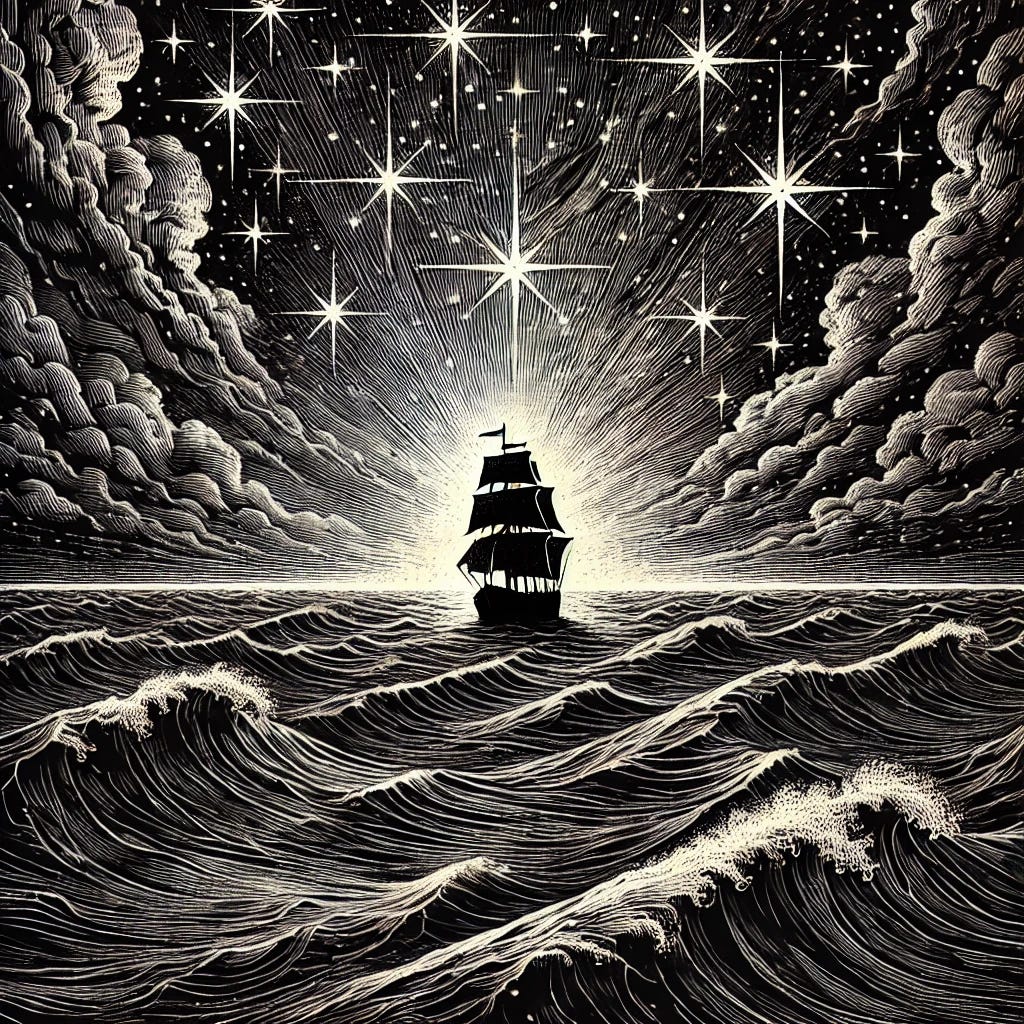
I must admit, I’m a total sucker for a Latin motto. And one about going to the stars? Irresistible. Ad astra, per aspera! What’s more utopian than that?
But if I’m being honest, it can feel a bit cheap, like a purely aesthetic statement — the NASA worm logo sticker on your laptop, a pair of leggings with a hyper-saturated space print. Yay space! Yay science!
And everyone always focuses on the “Ad astra” part. That’s the part you name a movie after, the part you get on a t-shirt. For some reason (probably because it feels like a bit of a bummer), everyone is quick to drop the other half: Per aspera. Through hardship.
But that, I think, is the part that makes it utopian. Without it, the phrase is meaningless. Going to the stars isn’t some weekend diversion, it’s not a music festival. The more we learn about space, the more we learn how unforgiving it is, how forbidding the path. That difficulty — the per aspera — is what gives the saying its power and poignancy.
More importantly, “going to the stars” isn’t purely literal. It doesn’t just mean going to the stars. It means so much more. The stars point the way. They are a direction, an orientation. We — all of us, humanity — are going up, to health, freedom, prosperity, and flourishing. We are going to build a better world. And it’s going to be hard. So. Incredibly. Hard.
I.
Admittedly, I had the idea for this essay months ago, and the world looked a bit different then. Now, there’s a part of me that feels foolish writing anything vaguely hopeful. ‘How can you talk about building a better world in a time like this,’ I imagine you saying. ‘We’ll settle for keeping this one from dying.’ Despair is the mood of the day and optimism of any sort sounds a bit flippant.
My entire generation was born into a difficult position, psychologically. When we were kids, Francis Fukuyama was talking about “the end of history” and the ultimate victory of the American way of life. And almost immediately thereafter, things started to fall apart. It was like waking up from a full night’s sleep at the top of a rollercoaster.
We were told that we would grow up in prosperity and stability, then get good-paying jobs that also saved the world. Instead, my generation has studied to tend libraries that don’t exist. We have worked at non-profits that raise money to fund their fundraising. We have paid rent by begrudgingly writing micro-copy for e-commerce platforms. And the last 23 years seem best understood as series of interlocking catastrophes.
It should come as no surprise then that so many of us feel like each dark development is a sign that things will continue to get worse from now on and forever.