
What’s so bad about being a hivemind?
I first wondered this while reading the Leech. I hadn’t heard of it before I pulled it off a shelf in a bookstore, and this paragraph on the jacket is what hooked me:
For hundreds of years the Interprovincial Medical Institute has grown by taking root in young minds and shaping them into doctors, replacing every human practitioner of medicine. The Institute is here to help humanity, to cure and to cut, to cradle and protect the species from the apocalyptic horrors their ancestors unleashed.
A hivemind doctor protagonist in the post-apocalypse? Hell yeah! I was sold.
Unfortunately, after a short spell of cool hivemind stuff at the beginning, one of the doctor’s hosts becomes isolated, and… becomes individual again, which the author deems a good thing. It doesn’t matter that the Doctor was the most intelligent, benevolent, optimistic, hard-working character in the whole story — hivemind bad, individual good.
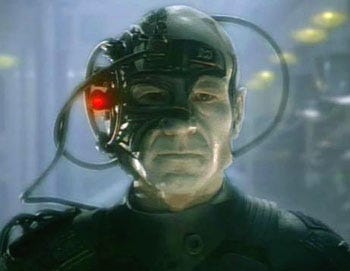
There are two primary kinds of hiveminds. The first is the assimilating collective. The best, most classic vision of this kind is The Borg from Star Trek: The Next Generation. The drones and the collective do not experience joy or beauty or love. They have no meaningful ambition. Everything is optimal, nothing is wonderful. It’s a managerial dystopia.
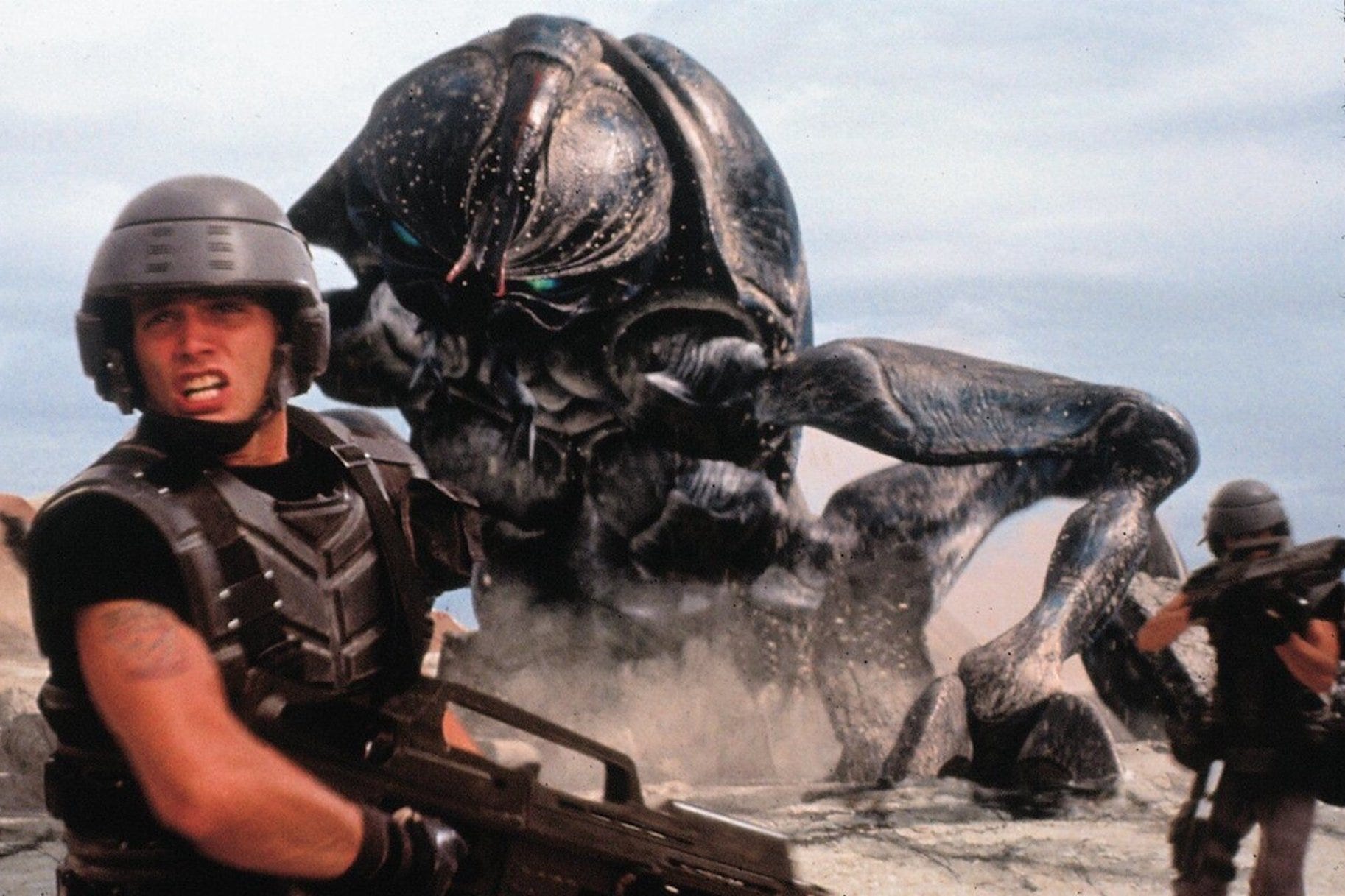
The second most common variety is the space bug hivemind. Starship Troopers sets the template for this variety. Somewhere in space is a race of giant bugs. They reproduce quickly, they’re expendable, and they’re all on the same page. This is a thinly veiled metaphor for Communism (if you want to talk about Nazis in space, you create an Empire; if you want to talk about Communists, you create a hivemind).
In short, hiveminds are evil because they will either forcibly assimilate you, replacing your individuality with the miserable, grey consciousness of the collective, or they will steamroll your society full of individuals with the superior numbers and coordination that come with being a collective of expendable drones.
What I find so interesting is that our cultural assumptions about hiveminds are so deep. We basically know they’re evil from jump, and the logic seems to work upstream. Leech, for instance, assumed that I would be so ready to understand the hivemind as evil that it didn’t really have to make its case.
This is in part because the trope plays so well when combined with Horror. In Horror, it does all the things you need a monster to do: it’s implacable, it takes away your loved ones, it threatens to consume you without your consent, you can never run fast enough to get away. Or, when deployed in an Action story, it gives you unlimited cannon fodder that you don’t have to sympathize with.
I find this all very boring. Whereas Horror is about fear and powerlessness, and Action is about excitement and empowerment, Science Fiction is all about curiosity. I’m interested in hiveminds almost solely because I’m interested in the other forms that intelligence and consciousness can take. We are only one possible configuration for intelligent life, and it would require a wild amount of human chauvinism to assume that we are the best. Although they involve aliens and laboratory experiments, these are merely pretexts in stories like Invasion of the Body Snatchers and Stranger Things.
And Science Fiction has indeed explored hiveminds in neutral or positive ways, except that as soon as they’re deemed “good”, they tend not to be called hiveminds anymore:
The Tines in Vernor Vinge’s A Fire Upon the Deep are pack-minds — individual dog-like creatures that only achieve consciousness in groups of 4-6.
The Sensates in Sense8 are psychically linked humans who share experiences while maintaining fierce individuality.
Theodore Sturgeon’s gestalt in More Than Human connects outcasts into something greater while preserving what makes them themselves.
Ender’s Game has a space bug hivemind — the Formics — and to its credit, portrays the violent conflict between them and humanity as being due to a shortfall on humanity’s part.
Notice though: they’re all non-assimilationist. We can tolerate collective consciousness as long as it doesn’t threaten to include us. The moment a hivemind wants to expand, to invite others in, we code it as evil.
There’s no reason there couldn’t be a good assimilationist hivemind though. What if it just made its case, asked nicely, and kept showing up? That, basically, is what the Federation does in Star Trek.
The Federation promises not to interfere in the internal affairs of other societies. It doesn’t conquer by force, it does not coerce. They show up on your doorstep with a pie. They want to know about your culture, they want to try your food and your music, they want to extend a hand in friendship, offer you a glass of root beer. They hope that someday this will be enough to convince you to join them.
So what would it look like if a hivemind operated this way? What if it used the Federation’s patient persuasion rather than the Borg’s violent assimilation?
In the first fifteen minutes of Pluribus, scientists discover a signal from space. Somewhere out there, an antenna the size of Africa has been beaming out this repeated message for millions of years. It contains a RNA sequence, and once it gets into the human bloodstream, it begins converting every individual on Earth into a hivemind. A few days after the first infection, only 13 individual humans remain due to their innate immunity.
All the elements of a classic, “hivemind bad” story are present, but their meanings have been changed. The hero is not the great and noble individual who will save us. She’s a miserable, selfish, incurious person that you wouldn’t want to share a beer with. She is never happy, she swears and drinks and falls asleep on the couch watching the Golden Girls. She can’t dig a hole or feed herself without the apparatus of American commerce. If I could say only one thing about Carol, I’d tell you that she’s a grasshole: despite living in Albuquerque, one of the driest cities in the country, Carol chooses to keep a well-watered lawn.
By contrast the hivemind seems… fine? They say they’re happy. It’s clearly established that they can’t lie, so we can be confident that’s true. They’re ending climate change and exploitation. City lights are shut off at night, wildlife is returning, people spend the night in shared sleeping arrangements. Every bad thing about them seems designed to invert a trope. They eat people! Only once they’ve died naturally, a contribution to feeding the world that they value. They don’t have personal relationships with pets! But buffalo and coyotes and other wildlife are returning to the places they once roamed. They can’t make art! Arguably we only make art because we’re so isolated that we can’t sufficiently express ourselves or understand each other. Everyone is fed, everyone is sheltered, and everyone receives medical care.

There is one other individual human that wants to stand against the hivemind though: Manousos. Whereas Carol represents selfish, misanthropic individualism, Manousos represents rugged, brutal individualism. He is stubborn, hostile, uncompromising. He will survive on dog food before accepting a meal from the hivemind, light his own car on fire before leaving it behind, try (and fail) to cross the Darien Gap rather than accept their help. Our species has made it this far thanks to men like Manousos. But he reminds me of the classic novel I Am Legend; once humanity has been replaced by “monsters” who form their own society, the last human being that stalks them in the night becomes the monster.
Pluribus does intentionally what Leech does accidentally. The hivemind is careful, competent, compassionate; the individuals are panicky, stupid, and selfish.
And there’s one important detail here that I haven’t shared yet: Carol is an alcoholic, an addict.
Why is this so important to understanding the story? Because addicts want something that’s bad for them, and Carol wants individualism like she wants booze. Individualism is killing us and the planet. It’s the source of so much pain and suffering, and we really, really want it. We don’t want to stop being individuals, no matter the cost. We kick and scream: Give us Lean Cuisine and grass lawns in the desert.
We want consent to be more clear cut than it is. Yes means yes and no means no. Except that we recognize some conditions don’t allow for clean consent. Children can’t consent to refuse their parents’ care. An addict in crisis isn’t in a position to refuse the intervention that might save their life. Or, as the hivemind in Pluribus puts it, you don’t ask a drowning person if they want to be saved. We accept that sometimes transformation is necessary even when the person being transformed would say no. We are kittens, hissing and huddling in the back of our cages, afraid of the doctor who wants to give us medicine.
The name given to the hivemind in Pluribus is “the Others”. They see the message from space as a gift. It was here before humanity evolved, before we made the first stone tool. But only once we were able to make radio telescopes and edit genes were we able to find it and do anything with it. Because that’s the exact moment we need help.
Around episode three, I predicted a detail that didn’t come until later: the Others plan to build another telescope to pass on the gift. It’s only natural: The last step of The 12 Steps is to take this message to others.
This all makes perfect sense when you consider Fermi’s Paradox. It is roughly this: based on what we know about biology and the cosmos, we should be able to look up to the night sky and find signs of alien civilizations pretty easily, so why can’t we? There are a number of solutions. Maybe we’re early. Maybe we’re wrong in some of our assumptions. Maybe they’re hiding (the Dark Forest Theory). Or maybe, intelligent species all die out for some reason. Maybe there’s some challenge that they all encounter that keeps them from going on. This idea is known as the Great Filter.
It’s possible that we’re up against the Great Filter right now. We’ve invented vaccines and grocery stores but also nuclear weapons and climate change. Do we have the wisdom to continue past this point, or will we destroy ourselves?
In this light, the message really does seem to be a gift. We, as a tribal species, sort of suck at collective action problems. We’ve been trying to solve them through social technologies and coordination mechanisms for all of history, but they never stay beaten. What if the only way to overcome that enormous problem is to give up our precious individuality? It got us this far, but perhaps it can take us no further. Our attachment to individualism might be nostalgia for a failure mode — a configuration of consciousness that was adaptive in our evolutionary past but catastrophic at civilization scale. Perhaps we should welcome the joining, perhaps we should see it as a gift.
It is a given that a human hivemind would leave behind some traits of tribal humanity. There would be no need or purpose for so much of our art and our lifestyles. But it would be foolish to port our ethics to such an organism. If it’s happy, if it can experience beauty, if it lives in harmony with all living things… would that trade be worth it?
We are basically trying to accomplish the very thing that the hivemind is so good at. What is liberal society if not an attempt to create structures that connect us in spite of our differences? The Federation is persistent. It shares its culture with you, it engages in trade. They are perfectly friendly and pleasant and diplomatic, and they hope that eventually their efforts will change you.
There’s a moment in Deep Space 9 where Quark offers Garak a ‘human drink’ — root beer:
Garak: It’s vile.
Quark: I know. It’s so bubbly and cloying and happy.
Garak: Just like the Federation.
Quark: But you know what’s really frightening? If you drink enough of it, you begin to like it.
Garak: It’s insidious.
Quark: Just like the Federation.
The Federation ideal — a society that ends scarcity and cruelty without changing what humans fundamentally are — is what I want. My politics are Utopian. I believe we should use diplomacy, science, education, and art to create a world where no one suffers or goes hungry, where we explore space in curiosity. Star Trek suggests we might achieve this without changing what humanity is. It says that we don’t need genetic augmentation or to hand judgement to machines in order to end scarcity and cruelty and coercion.
But do I think it’s possible? As a Utopian, I’m dedicated to saying it’s possible, to compelling myself to believe even when the world causes my belief to waver. But I truly don’t know. I don’t think anyone can know, and our estimations have more to do with the strength of our hope and courage than any rational calculus.
I personally would not want to join a hivemind. I see too much of myself in Carol: I can be a bit of a misanthrope and an introvert (though hopefully I’m a bit more curious, capable, and forgiving than she is), and I don’t really want to be directly connected to the rest of the species. But maybe that’s just my addiction speaking.
"Peace on earth, Carol. What's wrong with that?" Sign me up.
We called them The Smurfs. My partner was very pro-hive mind. I remain in the Carol camp. It's a fun talking point.