
Welcome back to Other Worlds Catalog, and hello to my new readers. This newsletter is about speculative fiction, utopianism, and imagining how things could be different. Today I'm continuing a thread from my last piece on disconnecting from tech.
In my last essay, I laid out all of the ways I have tried to redefine my relationship with technology. In 2025, I made an attempt to escape the ecosystems controlled by the big tech firms — Meta, Alphabet, Amazon, Apple. In many cases I succeeded, but my smartphone refused to be replaced.
Imagine you are standing in a field holding a rock, and you throw it as hard and as far as you can. Then you look down at your hand and there is the rock. That’s how I feel about my phone.
I’ve gone to war with my phone. I’ve stripped out every unnecessary app and notification. I’ve deleted the accounts associated with those apps. I’ve installed a powerful, scheduled blocking service. You might say I’ve succeeded. My phone does not feel abusive to me anymore. But this raises the question: why did I need to do all of that just to have a healthy relationship with this device?
Phones are designed for consumption. We have been told by the big manufacturers that this is what people want, this is consumer choice. Consumers want bigger phones with brighter screens. They want to be able to do more, ever more with these devices. They want to watch movies, scroll TikTok, record videos, play video games. It isn’t the manufacturer’s fault that the product ends up so addictive. Hey, they even put in some features to help limit the time you spend on your phone! Not good ones, but still.
I don’t buy it. I bought the iPhone 13 Mini in 2022, right after it was announced that it would be discontinued. It’s big compared to many of the smartphones that came before it, but every single flagship smartphone from a major manufacturer since then has been significantly larger. Over the years, I’ve gotten many compliments on how “small” it is. I’ve noticed that there is a bit of a cult following for this device online. Specifically, it’s beloved by people who want to use technology intentionally, who curate how they use their attention and what stuff they allow into their lives.
It may not be an enormous market, and there may be many more people who want larger phones, but it’s a market nonetheless. Why then haven’t the major manufacturers made even the slightest gesture toward a smaller phone in the intervening years?
Putting on my tinfoil hat for a moment, I believe that the manufacturers have incentives that go beyond the bare sales numbers for different phone models. Namely, Apple and Google get a cut of all paid transactions through the App Store and Play Store — paid apps, subscriptions, micro-transactions. If you have a phone with a bigger screen, you may be more likely to use it for more consumption activities, like renting movies and buying games. On top of that, wireless data providers like Verizon, AT&T, T-Mobile make more money if you use more data, which may explain why they’re so keen to sell new phones to consumers at steep discounts or even give them away. If my theory is correct, it’s not that no one wants to buy a small phone, it’s that nobody wants to sell you one.
Regardless of the particular forces involved, the modern smartphone has coalesced around a singular, omnipresent form: the Big Glass Slab (or BGS). Phones have all settled on a nearly identical design and become almost indistinguishable. Slightly different colors, slightly different camera arrays, but basically the same. They are optimized for the consumption of content, any time, any where.

We have seen the effect it has on us as individuals and as a society: Depression, anxiety, isolation, distraction, radicalization. This isn’t incidental. These devices are engineered to capture attention, manipulate mood, and quietly reshape what you want. (I’m going to use “abusive” as shorthand for the negative effects of these devices throughout this piece.) It has given rise to the common refrain “Obviously it’s the phones.”
For years, there has been virtually no alternative. But now, there are some small companies that have started bringing some alternatives to market. They diverge from the BGS in different ways — size, shape, screen technology. They hope to offer a way out of the paradigm we’ve all been trapped in.
What I find interesting is that these devices all put forward different theories of the problem and therefore its potential solutions.
1. The problem is that smartphones do too much
Let’s start with the obvious. The cell phone existed long before the BGS paradigm, and while there were social ills associated with them, they didn’t seem to be driving us insane. So why don’t we just go back to using those?
I had a flip phone in high school, a silver and cherry red Samsung SCH-a950. It made calls, sent texts, took blurry pictures, and could theoretically play music if I’d bought the special earbuds from Verizon. I loved that phone. I still have it somewhere.
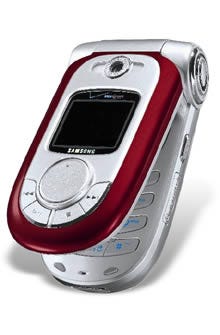
Those old phones mostly don’t work anymore since 2g and 3g networks have been retired, but you can get their modern equivalents, like the Sunbeam F1 Horizon (in a small concession to modernity, it can run Waze for navigation). Or if you’re feeling a bit more minimal luxe, you can get the Punkt MP02.
I can see the appeal. I have searched for “best dumbphones” almost every year since 2012 and ogled many an old Nokia. But I never pulled the trigger, and now I don’t think I ever will. This theory boils down to: If the phone is janky and unpleasant, I won’t use it. Texting is bad, taking a picture is bad, navigating any interface at all is bad. Maybe I could do that if I were still in my early 20s — maybe I would want that if I were still in my early 20s. But I don’t think it can be a real solution for a mainstream audience.
2. The problem is that dumbphones do too little
Even when we go wrong, the answer is very rarely “go back”. The dumbphones of yesteryear don’t make sense in 2026. Maybe the dumbphone of yesteryear was better for us, but if we want to meet some of the reasonable demands of modern users, we need new devices that take advantage of progress in technology and design.
I would include the Light Phone III and Mudita Kompakt in this category. They are shaped a bit more like smartphones and have touch capacitive screens, though they’re smaller. This allows them to run some slightly more sophisticated software while being more user-friendly.
But they restrict the basic functionality to a small set of bespoke apps or “tools”. For the Light Phone, that means: calls and texts, alarm, calculator, calendar, directions, directory, hotspot, music player, notes/voice memo, podcast, timer, and camera. The Mudita Kompakt has those, and a few more: e-reader, weather, chess, and a meditation timer (though it lacks a hotspot). The Kompakt can also sideload apps, but it doesn’t have Google Play services, compatibility may be mixed, and none of it is optimized for the e-ink screen.
I personally own and have tested the Light Phone III, and I really like it. Some evenings or weekends, I turn on call forwarding and leave my iPhone at home. At times, I’ve caught myself unconsciously reaching for my pocket purely for the dopamine in my smartphone only to find the Light Phone there instead, and I’ve felt like laughing. Damn! Foiled by myself! I don’t miss the abusive and addictive parts of my smartphone at all; I’m glad to be rid of them.
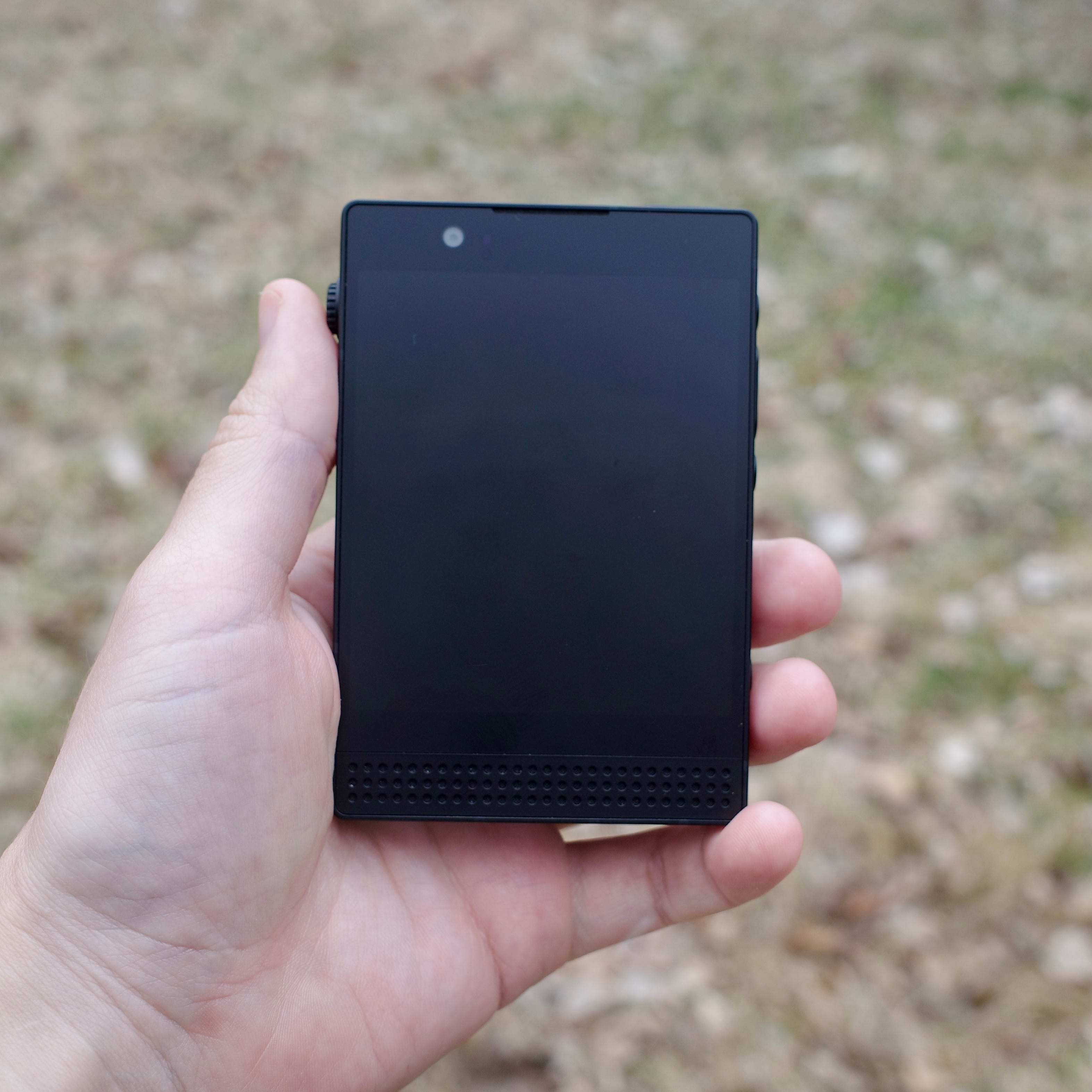
But I’ve never been able to make the full switch. As someone who works remotely, I have worked really hard to banish and minimize work functionality on my phone, but man, sometimes I just gotta check that calendar. And even if I gave that up or found a workaround, the smartphone has been so woven into our lives — boarding passes, QR code menus, apps for kids’ soccer leagues and restaurant shift scheduling — there are still a few innocuous functions that are hard to part with.
The Light Phone is a great detox device, but I think to fully commit to it, I’d need to carry a second smart device and that feels like trying to get a fishhook out of your finger with another fishhook. Besides, Verizon doesn’t currently offer NumberShare for this device, call forwarding is a partial solution, and SIM swapping is annoying.
Maybe I should just suck it up and make the switch, but I’m not sure I should have to. My banking app isn’t the problem, nor is my fitness app. Some of my apps are fine!
3. The problem is that phone screens are hypnotic
So much of what’s harmful in our smartphones has to do with their displays. They are large, glossy, vivid, dynamic. The human brain is wired to seek that kind of novelty and these OLED displays give it immense power. So if we just changed the display technology to something less stimulating, maybe we could cut it off at the knees while still enjoying the powerful capacities of the smartphone.
Devices like the Boox Palma, Bigme Hibreak, and Minimal Phone are basically just Android phones with e-ink screens. They have a little custom firmware to bridge the default Android experience with the e-ink experience, but otherwise you can download basically any app you want, visit any website, do anything you’d do on an ordinary phone. The catch is that you’d be doing it on a black-and-white screen with a poor refresh rate. Suddenly, YouTube and TikTok don’t seem so appealing.
I own a Boox Palma (which is technically a “tablet” because it lacks a SIM to connect to cell networks) and I can confirm that e-ink truly changes what you want to do on a device like this. It is excellent for reading (there’s a good reason why its primary use case has been e-readers) so I tend to use it more to read articles or look something up quickly. It’s like a nicotine patch for my phone in that way. It mostly lives on my nightstand while my phone charges in another room, but I have taken it around town a bit too and can imagine the ways in which it might substitute for a full-fledged smartphone.
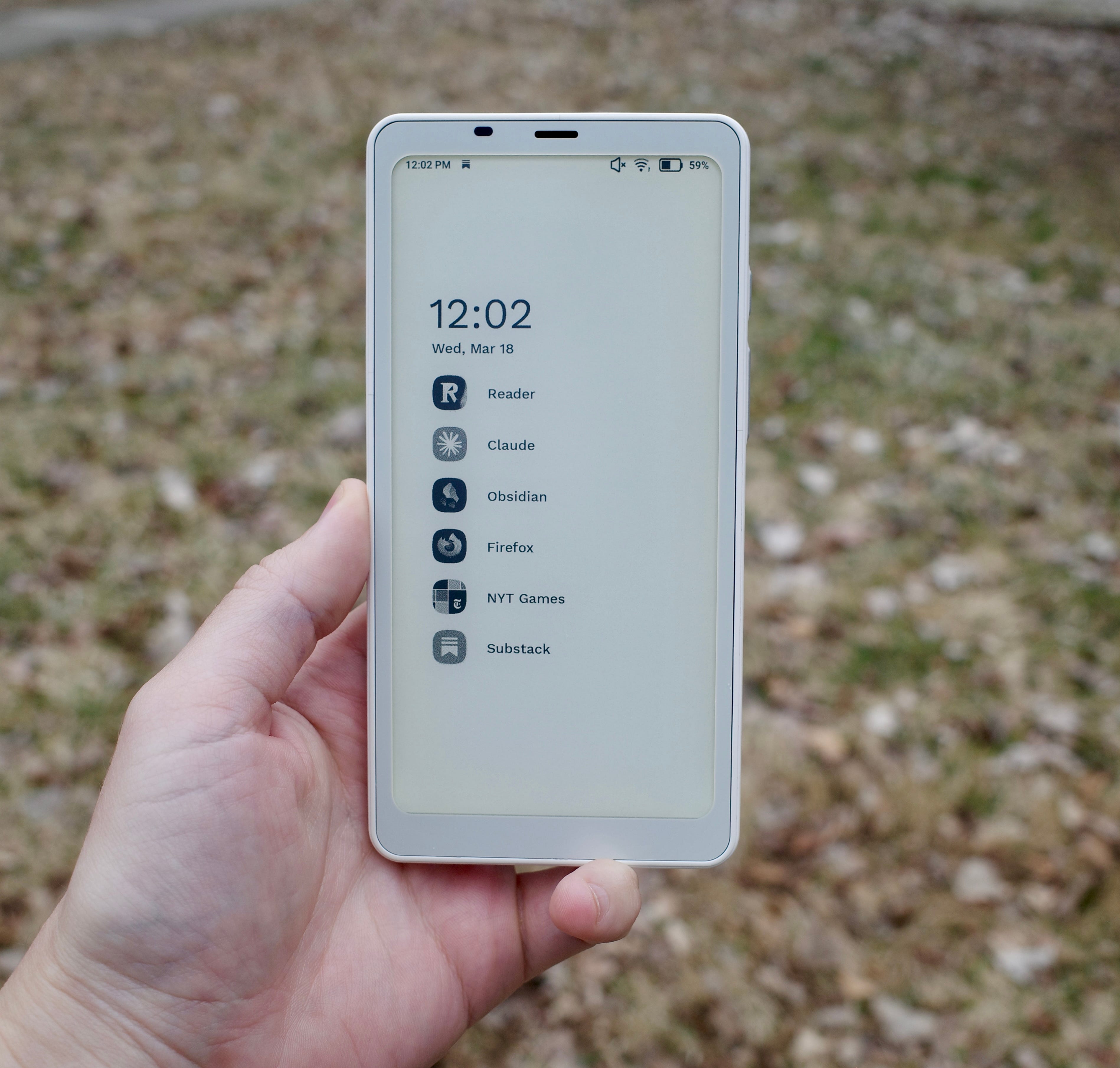
Still, they’re not addiction proof. A lot of addictive and abusive phone interactions are purely text-based. While I haven’t had an account on a micro-blogging platform in years, I do have a Substack account (obviously), and after my last piece went viral, I found myself increasingly addicted to the notifications and Substack Notes, which I mostly consumed on my Boox Palma. Turns out you don’t need a beautiful color screen to make a Skinner Box!1 They are still capable of infinite scrolling — a super-charged version of channel surfing — which creates an intermittent reward schedule, and thus addiction.
Also, the poor refresh rates of e-ink don’t just make it hard to watch videos, it means that even some basic functionality is fairly janky. Typing is unresponsive and navigating apps that aren’t specifically designed to work without color can be rough.
I love e-ink as a technology. My Kobo is now my preferred way of reading books. But I think as an answer to the smartphone, it draws the line in the wrong place. TikTok and YouTube become almost impossible while reading becomes a delight, but it’s perfectly possible to scroll feeds, and maps and the camera remain genuinely janky.
It’s enough of a problem that these companies are working hard to overcome these limitations by… increasing refresh rates and developing color e-ink. Isn’t that just a regular smartphone again?
4. The problem is that phones can download abusive software
The three previous theories have something in common: They all try to solve the smartphone problem by downgrading the device. They try to use form factors, hardware limitations, and bespoke software to make the phone less powerful, and in doing so they either make it less useful, fail to remove all of the abusive elements, or both.
But what if there’s actually nothing wrong with the design of the modern smartphone? Perhaps we can have our big screens and powerful cameras and access to all of the bounties of the app store, minus anything addictive or abusive. If the problem can be located to specific uses of the phone, we could build operating systems that simply don’t allow for those behaviors.
That’s what the Sleke Phone, Wise Phone, and Balance Phone are trying to do. I personally own the Sleke Phone, so I will speak to that one primarily.
In terms of hardware, the Sleke Phone is just a Google Pixel 7, which is a totally respectable phone in our current age of plateauing smartphone design. But it runs a forked version of Android that draws a hard line between what you can and cannot do. The key feature is that you can only download whitelisted apps. This could be almost anything, no matter how obscure, so long as it isn’t for consumption. The Sleke Phone even goes so far as to eschew a browser. You can use an LLM chatbot to find and show you individual pages you may need, but you can’t navigate around the internet freely.
I had been thinking about the phone problem for a long time when I first heard about the Sleke through a video on YouTube and I ordered one almost immediately. Conceptually, the idea of blocking abusive consumption at the level of firmware with scalpel-like precision was fascinating to me. In practice though, I had two serious issues.
First, because these devices use modern smartphones as their base, they have average-sized screens, which is to say, enormous screens. As we’ve established, the very purpose of those huge screens is to display consumable content, but they’re mostly useless when you run an OS like this. It feels totally incongruous, like driving a Ferrari with the engine of a Honda Civic. This problem isn’t inherent to the concept though; the OS could run on a smaller phone in the future.
My second issue is more fundamental. Who decides what counts as “consumption” and what counts as “utility”? Sleke’s founders, of course.
When I first got the phone, I requested that a few apps be whitelisted. The founders accepted a few of my requests, but they rejected my requests for Strava and Instapaper because they considered them to be consumption. Personally, I use Strava purely as a fitness tool to upload workouts. There is theoretically a feed of your friends’ workouts, but I’ve never had more than five people in my contacts that I could follow, nor have I wanted to spend more than 60 seconds looking at little orange lines indicating where they recently went for runs. And Instapaper is for reading saved articles, which to my mind is perhaps the healthiest thing I ever use my phone for. But I guess an article is visual (bad), whereas a podcast is audible (good)?
My issue is not that these two calls were the wrong ones or with the Sleke founders’ particular perspective (they seem like really nice guys), but that the call will always rest with the person developing the software. It risks becoming paternalistic, and that’s no fault of the developer. As a user of such a device, I’m asking someone else to decide what’s right and wrong for me and hold that line. Yet almost immediately, the humanist in me rebels against what then feels like arbitrary restrictions.
5. The problem is that phones are designed for consumption
Implicit in all of these arguments is a division between consumption (bad) and utility (good), and though they come at it in different ways, each theory shares a core approach: they focus on making consumption worse / harder / impossible. But what if the answer lies on the other side of the equation? What if the answer is to design for utility instead?
This is the theory embedded in the recently announced Clicks Communicator. It’s an Android phone with a small, squarish screen and a physical keyboard; basically, a modern BlackBerry. And yet when I first saw it, I thought it might be part of the answer. (I pre-ordered immediately. The device is slated to ship later this year.)
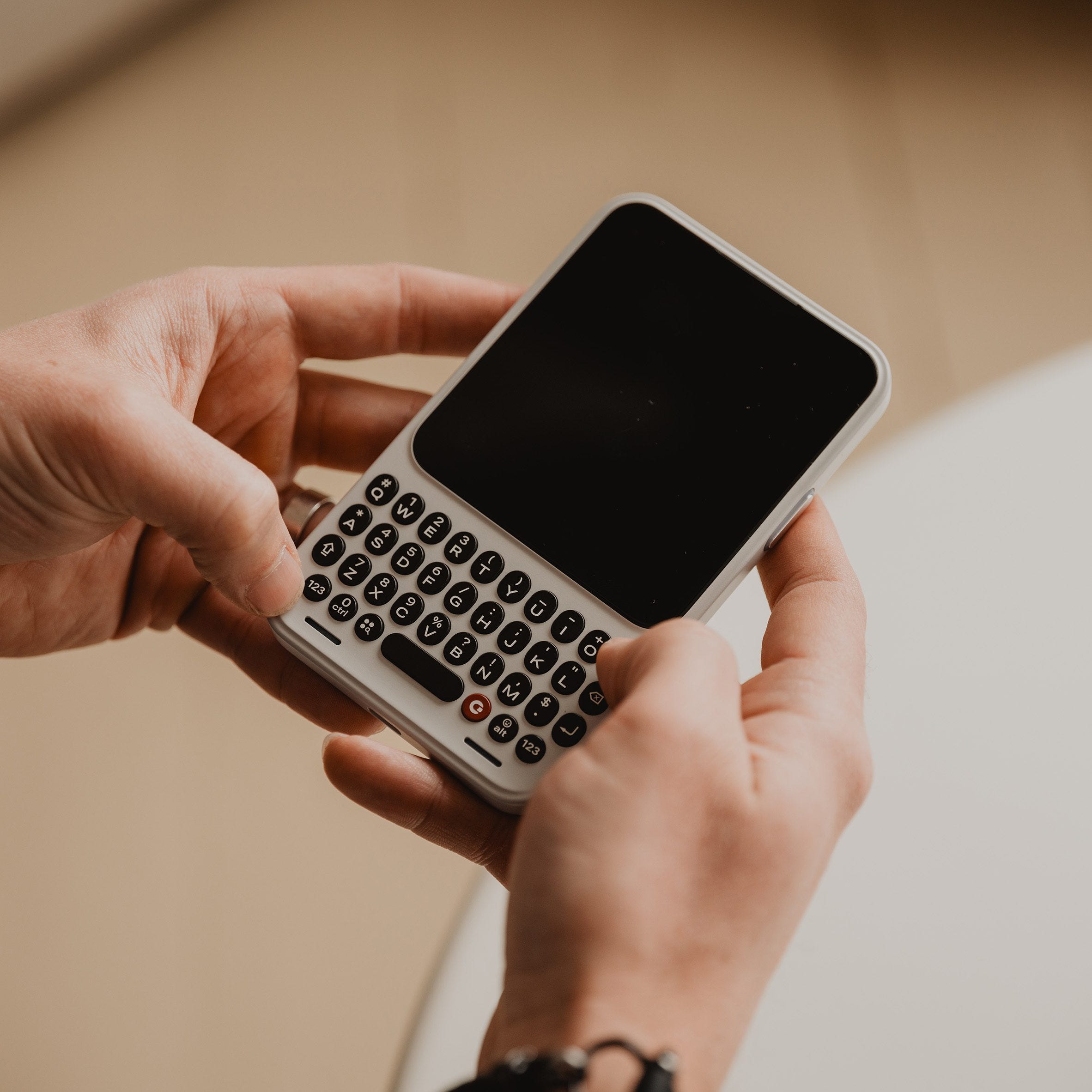
Though the word “dumbphone” has been thrown around to describe everything from flip phones to the Sleke, I don’t think you could call the Communicator a dumbphone, it simply does too much. Yet it’s also not quite a smartphone as we know it. The name itself suggests this: before the iPhone was announced and the word “smartphone” entered popular usage, this sort of device was often called a “communicator”.
I never had a BlackBerry, so I have to take people’s word when they say that the typing experience is better. But what the keyboard actually does is allow for the screen to be small while still maintaining functionality. Every element of the phone — the locked orientation, the shape of the back, the keyboard — is designed for it to be something that does quick and important tasks. Bang out an email, reply to a text, check some piece of information. But you wouldn’t want to browse or scroll for very long on it (I don’t think).
There is a real barrier for any phone that markets itself as an alternative to the abusive devices that most of us currently use: It’s hard to sell something that does “less”. Yes, I’m interested in all of these devices and willing to tinker until I find my optimal experience, but I’m a weirdo! We can’t afford for healthy technology to be a niche phenomenon, and it turns out, most people are turned off by products that are marketed for their wholesomeness and benevolence.
I remember being in a burrito shop years ago, and there was an old poster advertising Moxie Cola and Diet Moxie. The can of original Moxie said “Great taste”, and in the same place on the can of Diet Moxie, it said “Fewer calories”. Which really makes you wonder, does Diet Moxie not have “great taste”? That’s how a lot of the positioning for these good-for-you phones comes off to me: “This phone is better for you because it’s a bad phone.”
The Communicator solves this problem by being for something rather than against it. Clicks designed a phone that was genuinely excellent at the things people actually really do need phones for: communication, quick reference, getting things done. The small screen and physical keyboard follow from that design brief. And as a byproduct — not a feature, a byproduct — the phone is pretty bad for consumption. You could load Instagram or TikTok but I don’t think you’d want to.
Of the options I’ve explored here, I think this design theory best locates the sweet spot between functionality and benevolence. It doesn’t ask us to try to go backwards, to close ourselves off, to introduce meaningless and arbitrary friction and roadblocks, or to hand our judgement to someone else. It just makes a phone that’s good at being a phone and bad at being a slot machine.
The real solution is…
Personally, I don’t think the classic dumbphone, the restrictive operating system, or the e-ink phone get to the root of our problems. They add friction that helps in some measures and hurts in others, which is why none of them have broken through.
But in the other options, I see a few paths forward. I genuinely like the Light Phone III, and they’re planning to release an SDK that may help the device develop and mature. Only then will I know if it can make the leap from part-time phone to full-time phone. And I’m really excited to get my hands on the Clicks Communicator to see if it can thread the needle from the start. Until then though, I’m holding onto my 3.5-year-old iPhone Mini 13. I’ve basically beaten it into submission through app blocking and deleting accounts, as detailed in my previous essay, so I’m not in urgent need of a replacement (though it will only hold out for so many more years).
One thing all these options have in common? Small screens. Not e-ink, not sophisticated gatekeepers, not a T9 keyboard — just a small screen. Perhaps that’s the real secret, and the one thing the big phone manufacturers don’t want to give us. (There are rumors that Apple is finally going to make another phone with a smaller front screen. The catch is that it’s a foldable phone with an internal screen the size of an iPad Mini.)
Ultimately, the phones are just one part of the puzzle. They may be the doom portals that shape our experience of the internet, the thing that shaped the internet into the abusive, all-encompassing network it is today, but simply changing our devices will not fix what it has made. It leaks out of every WiFi connected device in your home and in the world you move around in. It has other ways to get at you, in particular through other people. But attacking the phone is a strong start to addressing the problem.
Also known as an “operant conditioning chamber”. If you put a rat in a chamber with a button that dispenses food, it will press the button a few times until it has eaten and is full. If the button does not dispense food, it will press the button only once or twice, then stop. But if the button dispenses food only sometimes, the rat will hit the button like crazy. That’s your phone.
I've played endless mind games when it came to my iPhone. I went off social media a long time ago (never happier) but my iPhone remained a problem. I am a nanny and have always been really consistent with not being on my phone around the small humans. However. I could feel my iPhone whispering to me from my pocket: 'Just look at me for a little bit.. Come on.. Hold me.. ' Such a horrid restless feeling. It's steeling away one of the most important things we possess as human beings: attention.
I dropped my iPhone and it broke. I ordered a dumb phone and thought: let's just see what happens and work out solutions as I go. Here are a couple of problems that have arisen so far and this is how I dealt with them:
Banking. My bank only exists on an app. I bought a second hand iPad mini that hangs around in the kitchen. I am not watching YouTube (especially YouTube shorts turned out to become a huge problem)
Train tickets: I take the iPad mini for a little trip outside with the downloaded tickets on them or I print them.
Directions: Now. This was my greatest worry- I suck at directions. Sometimes my fiancé just follows me to see what happens because it seems like I know where I'm going but I don't. This turned out to me a false narrative. I live in London and I know my way around the city pretty well. I just gotten used to always letting my phone do the work. I am 37 so I know life before smartphones. My brain just had gotten lazy. I look up directions before I leave the house and if I do get lost, there's a millions of people around me to ask.
Catching up with family/friends: My family lives abroad. I have signal installed on my iPad and in case of an emergency they know to call my dumb phone. I find myself picking up my phone and calling friends more often (which confused them in the beginning. They would pick up and shout: What's wrong are you ok??') I miss things from groups chat's etc but I find myself thinking: how important is it really? What I don't miss is the constant noise.
Taking pictures: simply replaced by a camera.
Like you, my smart phone is designed to be dumb. It became less dumb because of Substack so I recently went nuclear and followed all the Substacks I was following with my rss reader instead, and deleted the substack app on my phone. Now my phone is back to reading only, no notifications, but still all the useful things like maps and digital tickets. I’m so with you though that it’s annoying how much effort it takes to have the glass slab be a good part of our lives instead of a bad part!
Thanks again for sharing your experience. I’ve been loving these.