
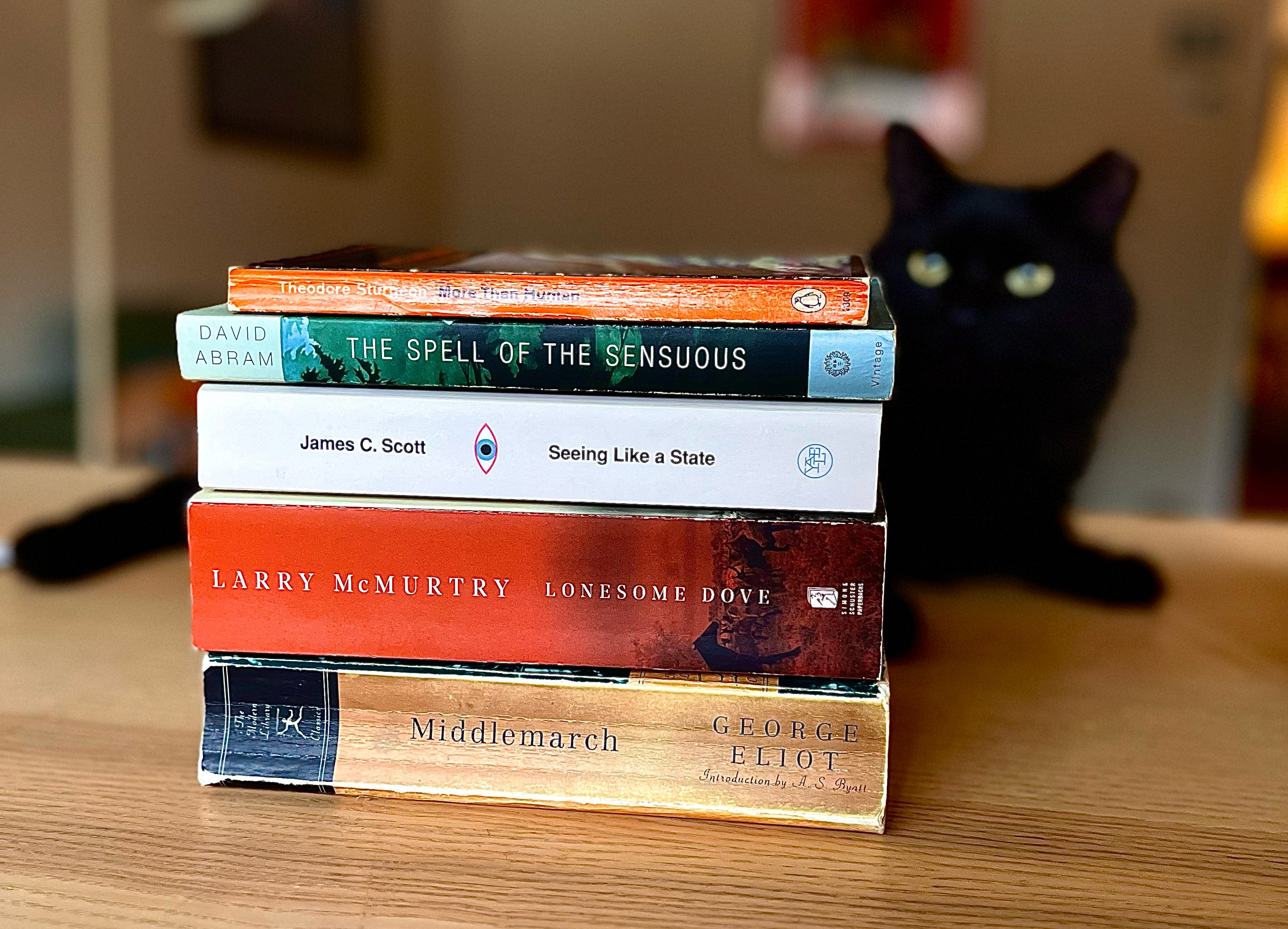
I’ve got no love for the end-of-year round-up lists put out by big publications. Often, they represent a certain amount of critical acclaim and book sales — taste that is either smoothed over or rarefied to appear authoritative.
But I absolutely adore the lists made by my intelligent friends (and intelligent people I aspire to befriend someday). These lists have much more quiddity to them; they speak to where our taste and curiosity took us in a year, and in the background you can often glimpse a rich and textured life. (See: my partner’s round-up of the best things she ate this year.)
As a book person, I am honor-bound to share the best books I read during this orbit around the sun. Last year’s list was extensive. It had been an intellectually intense period and the themes that emerged were so strong, the books so deeply connected. My list is shorter this year, the themes a bit more tenuous — and yet there they are!
Literary fiction: Flourishing through connection
My personal theme for 2025 was “the Year of Connection”, so perhaps it should come as no surprise that I read several novels that deal with this directly, but none were chosen for that purpose. Maybe something subtler than conscious thought moved me to these selections.
Middlemarch may hold the record for “book that sat on my shelf the longest before I actually read it” despite the fact that it is so highly and regularly recommended. I blame my high school English classes for overdosing me with 19th Century marriage plots — Jane Eyre, Pride and Prejudice, Wuthering Heights, The Scarlet Letter, The Awakening. From these books I learned two things:
The 1800s were a terrible time to be alive.
Books are better if they have a ghost in them (and better still if you turn them into a Kate Bush song).
So I was very pleasantly surprised by Middlemarch! What can I say that you haven’t heard? Nothing, probably. It’s full of humor, compassion, humility, and ambition. It admires the sort of people who want to make great things of their lives and the world, and it appreciates how fraught that pursuit can be. And ultimately, flourishing is found through freedom; not the kind that allows us to be solitary and independent, but the kind that allows us to form nourishing connections with others.
Lonesome Dove is the story of some past-their-prime Texas Rangers who decide to go on one last adventure by driving a herd of cattle to Montana. In the telling, we meet all sorts of people that populated the West shortly after the Civil War — cowboys, saloon keepers, whores, gunslingers, and outlaws. So far, so Western.
But to my untrained palette, McMurtry strikes the exact right balance and tone for such a story. It isn’t fawning and nostalgic for a time when men were men; clearly, there is too much meaningless cruelty and hardship for that. But it also isn’t cynical and anhedonic (which seems to be the other, more respectable mode for a Western); these are real people with hopes and dreams, with humor and passion and stubbornness and ignorance. These people are looking for some comfort or happiness where there is so little to be found, and that is a noble, often doomed pursuit. Is this starting to sound familiar? About halfway through the book, I thought to myself “Why, this is like a Middlemarch of the West”. Sure enough, a character name dropped George Eliot a few chapters later.
A book this capacious can’t be reduced to a single line or sentiment, but let’s try anyway. At one point, the highly intelligent but uneducated Gus McCrae makes a sign for their small, middle-of-nowhere ranch, and thinking to give it an air of esteem, he adds a Latin motto:
Uva uvam vivendo, varia fit.
“A grape changes color by living (with other grapes).” Roughly, you are the company you keep. The West was full of hard characters because the living was hard, and the individuals in it are shaped, deformed, influenced, and enhanced by the people around them.
More Than Human slipped in under the wire; I literally finished it this week. It has also been on my list a long time, but it jumped up the queue as background reading for an upcoming piece I’m writing on hiveminds. In More Than Human, a few broken, outcast individuals with unusual abilities find themselves drifting together to form a gestalt, a whole that is greater than the sum of its parts. So uh, not quite the same kind of “connection” as the other two books.
It’s surprisingly fresh and lively for an SF book published in 1953. There are books from the 2000s that were acclaimed in their time and haven’t aged half so well. I’ll have more to say, so keep an eye out for that piece about hiveminds!
Science Fiction: Do they still make Hard SF?
I really love SF that’s philosophical, literary, or sociological, but now and again, I just want a big idea book. Gimme some really weird aliens! Gimme a technology that turns the world upside-down! I think I’d gone so long without that kind of thing that I really went looking for it this year.
For as big an SF fan as I am, you may wonder how I put off reading The Three Body Problem until now. Well, I’m a contrarian. It was on Barack Obama’s reading list, okay? I had older, weirder stuff to be reading.
What I like about TBP is that it’s an SF book, a real honest-to-goodness SF book. It’s not using aliens at a ✨metaphor ✨ to teach us about ourselves; they are aliens and what’s interesting about them is that they’re aliens. Thank god! TBP sets forth a premise and then spends the rest of the book caring very deeply about how that premise plays out. It lays out a formula, selects values for some of the variables, and then plays the whole thing out. It’s able to think about biology, history, technology, the nature of the Universe, game theory, and a dozen other things simply by taking its premise seriously. It’s as good as people think it is. And yes, the Cultural Revolution bit at the beginning is a bit of a slog, but I promise it’s important.
(I read the sequels as well. The Dark Forest is passable, but less interesting. Death’s End was a complete DNF.)
Children of Ruin is another SF book that takes its premise seriously. It’s the sequel to Children of Time the book with the sapient spiders, and in this one the premise is: sapient octopodes. (“Octopi” is wrong, “octopuses” sounds dumb — moving on.)
I can now say it’s the best SF book I’ve read about sapient octopodes (sorry, The Mountain in the Sea). Tchaikovsky portrays them as passionate, expressive, self-contradictory beings. Octopode society is characterized by contention and struggle, between their own arms as much as between each other. I imagine that humans must feel about octopodes the way that Americans sometimes feel about Australians: in some ways, we are more similar than our more civilized cousins, the British/spiders.
Tchaikovsky is doing some of the most thoughtful work on consciousness I’ve seen in SF in a long time. Clearly, he’s engaging with the scientific literature and the big questions. Is it possible to know what its like to be a different creature? Can we ever know if another being is conscious from the outside?
Without any spoilers, Ruin is also part of why I’m thinking about hiveminds, though this book doesn’t technically contain one…
Exhalation is a collection of Ted Chiang’s best work, much of which I’ve already read once, if not twice. I feel confident in saying that Chiang is the best SF short story writer of the decade, and of the century so far. The stories in this collection include:
The Merchant and the Alchemist’s Gate: Like a story from the 1001 Nights, but with plausible time travel.
Exhalation: A mechanical scientist does an auto-dissection.
The Lifecycle of Software Objects: Dedicated fans try to keep their maybe-conscious Super-Tamagotchi running across platform migrations.
The Truth of Fact, the Truth of Feeling: A new technology called “writing” really screws things up.
The Great Silence: Parrots wish we would talk to them.
Anxiety Is the Dizziness of Freedom: People get FOMO about parallel universe versions of themselves.
If that doesn’t make you want to read this collection, I don’t know what will.
Non-fiction: The problems of modernity
This was a lesser year for non-fiction for me. Why? Maybe it’s a corrective for how much I read in 2024. Also, most of the stuff I read this year just wasn’t as good. But when it comes to the stand-outs, I think the themes are contiguous with what I was reading about last year: legibility, control, progress, technology.
In Seeing Like a State, James C. Scott makes a simple argument: increased legibility and measurement become tools for top-down control by the state, which when over-applied can have catastrophic consequences. He recounts the failures of scientific forestry and centralized control to make his point, and from his critique, he moves on to advocate for what he calls “métis” — practical knowledge gained through experience, the kind of wisdom a farmer has about their land or a craftsman has about their materials.
Scott makes an intelligent and extensive argument, and he does it with measure. He’s always careful not to overextend his position, and (mercifully) he never falls into Graeberian sneering or contempt. However, because I tacitly accepted many of his premises before we began, I came away from the book with more counter-arguments than epiphany. Scott’s subject doesn’t really end up being the state, or even law and order, but what he calls “authoritarian high modernism”. As a rhetorical move, it positions a lot of the valid counterarguments outside the frame of the book. And while I think métis is an excellent concept, his argument fails to acknowledge its limitations or the ways in which even highly optimized organizations can employ it.
For all that, Seeing is a classic for a reason. If this is the sort of thing you like to read and think about, this book is a non-negotiable addition to your list.
I read The Spell of the Sensuous in the Spring and it gave me so very many thoughts that I’ve been trying to write an essay about it ever since (and I hope I’ll get it out in early 2026). Spell is about our connection to nature (or what the author calls “the more-than-human world”) through a phenomenological lens. Basically, our connection to that world is through the senses, which in turn are how we speak and perceive speech, forming a conduit with all living things (which, because this is animist, includes rocks and the wind and the Sun and such). This connection, the author argues, has been severed by a dangerous, insidious technology: alphabetic written language. He really didn’t know what was coming…
Spell is poetic while still being intellectual, and it doesn’t dissolve into pure sentiment, which can be the danger of books that try to convince us into environmentalism through nostalgia or beauty. I think it has so very, very much to say to our current moment, which is precisely why this entry is so short: I want to give it better treatment elsewhere.
What’s in my TBR for 2026
As I shuffle and peruse my TBR list, there are a few titles I’m excited about:
I’ve just started The Brothers Karamasov and I already feel like it will be on next year’s recap.
I’m a fan of the idea of Finite and Infinite Games, and it’s about time I get the thing direct from the source.
I need to read Black Mass by John Gray because he’s my mortal enemy and I need to know why he’s wrong.
I think Hannah Arendt tackles a lot of the stuff I’ve been thinking about in The Human Condition.
Notably: I am really scraping the barrel for good SF. Give me your recommendations, please, I beg you.
Thanks for reading in 2025. I hope to put out one more essay this month, but if I don’t, see you next year!
Thanks for this list, it looks interesting. Middlemarch made it onto my to-read list late last year after a Thackeray binge (recommended!) Coming up (again) is a (re-)read of The Devils, my favorite of Dostoyevsky's novels. I'm also very much looking forward to SF recommendations of the sort you described (also loved More Than Human way back when) and to reading the books you wrote about
Thanks for all the recs! I agree with you on the scifi section a lot, so i'll have to pick up the Chiang anthology!!
> It’s not using aliens at a ✨metaphor ✨ to teach us about ourselves; they are aliens and what’s interesting about them is that they’re aliens.
That's very interesting, because i do think the aliens in TBP are a metaphor for something, or at least they're not here just because they're aliens. Maybe metaphor is the wrong word, but the characters are communicating with them, so their presence is a pretense to imagine ways of making oneself understood to an entity that's so different. Idk if i'm explaining that well, but the meeting of their civilization and way of being with humans' is a thought experiment of sorts?
Maybe a better way of saying this: the alien in Alien are great because they're alien and that's what's interesting about them. But also they're symbolism for rape.
I do very much agree that it's nice to see hard scifi where the aliens are both interesting on their own AND also carry meaning. I don't love this new trend of only having half-baked aliens so they can be a stand-on for some idea or another!