
If you asked me who the greatest fiction writer in the English language was — living or dead — I’d give an answer that isn’t in many top ten lists: Gene Wolfe.
Wolfe wrote sumptuous prose, created characters with immense psychological depth, told powerful stories, and created intricate worlds. One could argue that he’s more like Nabokov or Proust than Asimov or Heinlein. And yet, he isn’t widely known. Why?
The genre label certainly puts off some more literary readers, but even SF super-fans often bounce off him. Though he has a huge catalog of brilliant work, much of it is a bad place to start. (I have personally turned more than one person off of Wolfe by handing them the wrong book.) And while there’s lots of good advice about how to read Wolfe on a line-by-line or chapter-by-chapter level, what to read is more opaque.
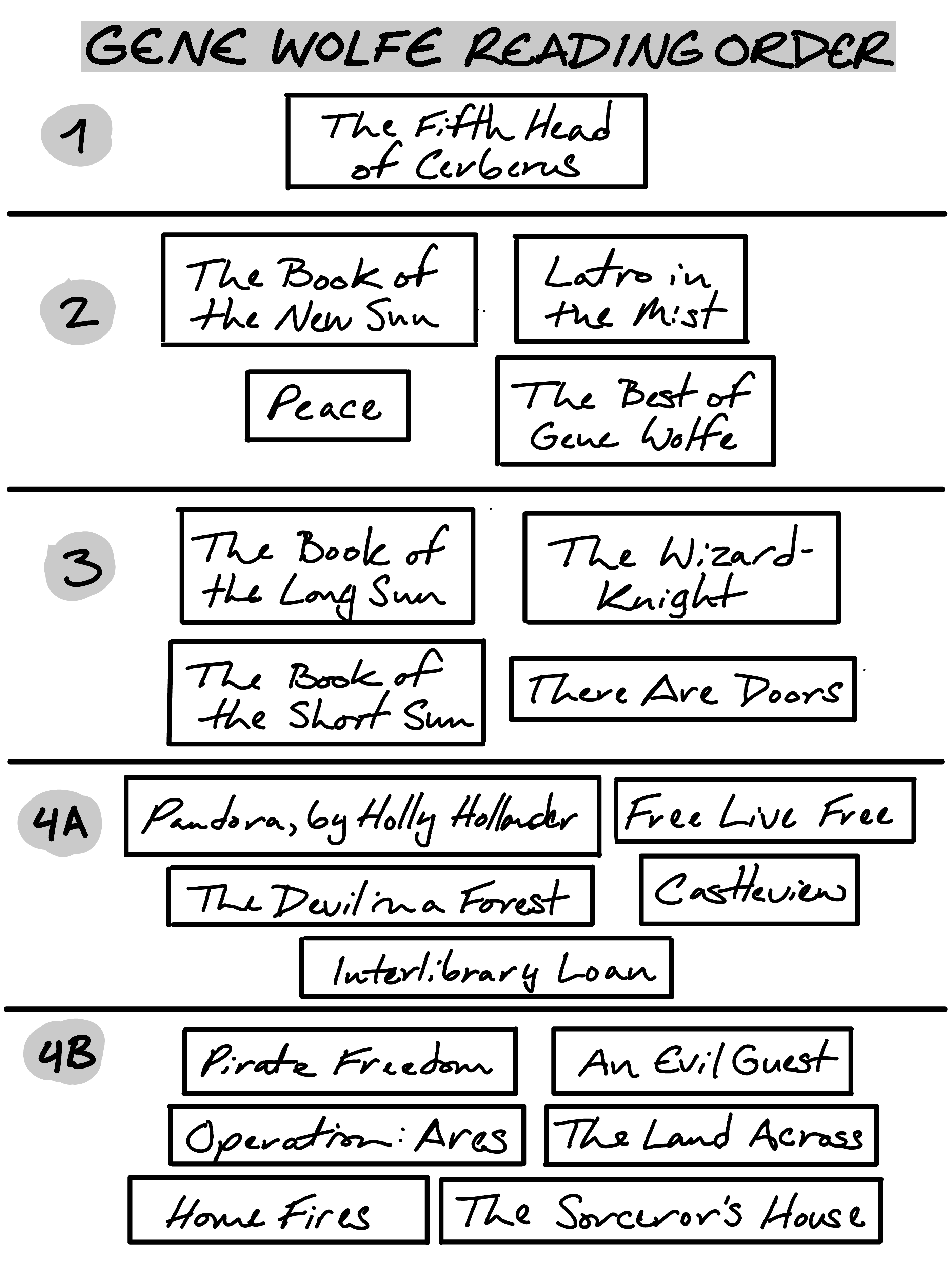
So, in the interest of making this great writer a little more legible, a little more knowable, I present a reader’s guide to the corpus of Gene Wolfe. (A visual version is included at the bottom of this post.)
1. Where to begin
I have determined that there is a correct place to begin with Wolfe: The Fifth Head of Cerberus.
Fifth Head is a collection of three novellas:
The Fifth Head of Cerberus (which gives the book its name), the memoir of the son of a mad scientist/brothel owner on a backwater colony planet
A Story by John V. Marsch, an anthropological recreation of the aboriginal life on the planet, ostensibly written by a character from the first novella
VRT, a lazy, low-level policeman rifles through a box of evidence in the criminal case of the second story’s author in no particular order
I have come to this answer after much trial and error. Fifth Head so clearly lays out what Wolfe does and how. The first novella is evocative and mysterious — full of misdirection, personal voice, and textured and economical world-building. It’s creepy and fascinating, and importantly, most reader’s will feel that they “got it” by the end. The second and third novellas are stranger and more opaque but the reader is more prepared for them, more aware of what kinds of games are being played. Both completely redefine what you think you know about the first. And crucially, the entire thing fits in one slim volume.
2. Certified classics
“Here I pause. If you wish to walk no farther with me, reader, I do not blame you. It is no easy road.”
Now, if that’s all the Wolfe you wanted to read, that’s fine. But if that whetted your appetite and you’re interested in more, here’s where you get to choose you own adventure:
If you want to read his magnum opus, a challenging and intricate puzzle box full of mysteries, a dark Science Fantasy series with a mystical bent, jump to: The Book of the New Sun
If you want a Greek Historical Fantasy — borderline Herodotus fan fiction — or if you just really loved Memento, jump to: Latro in the Mist
If you want something spooky, or you’re looking for something a bit more “grounded”, or if you simply feel like a standalone novel is more your speed, jump to: Peace
If you want to explore the entirety of Wolfe’s exceptionally broad palette, or if you would prefer to experience him in smaller doses, jump to: The Best of Gene Wolfe
The Book of the New Sun
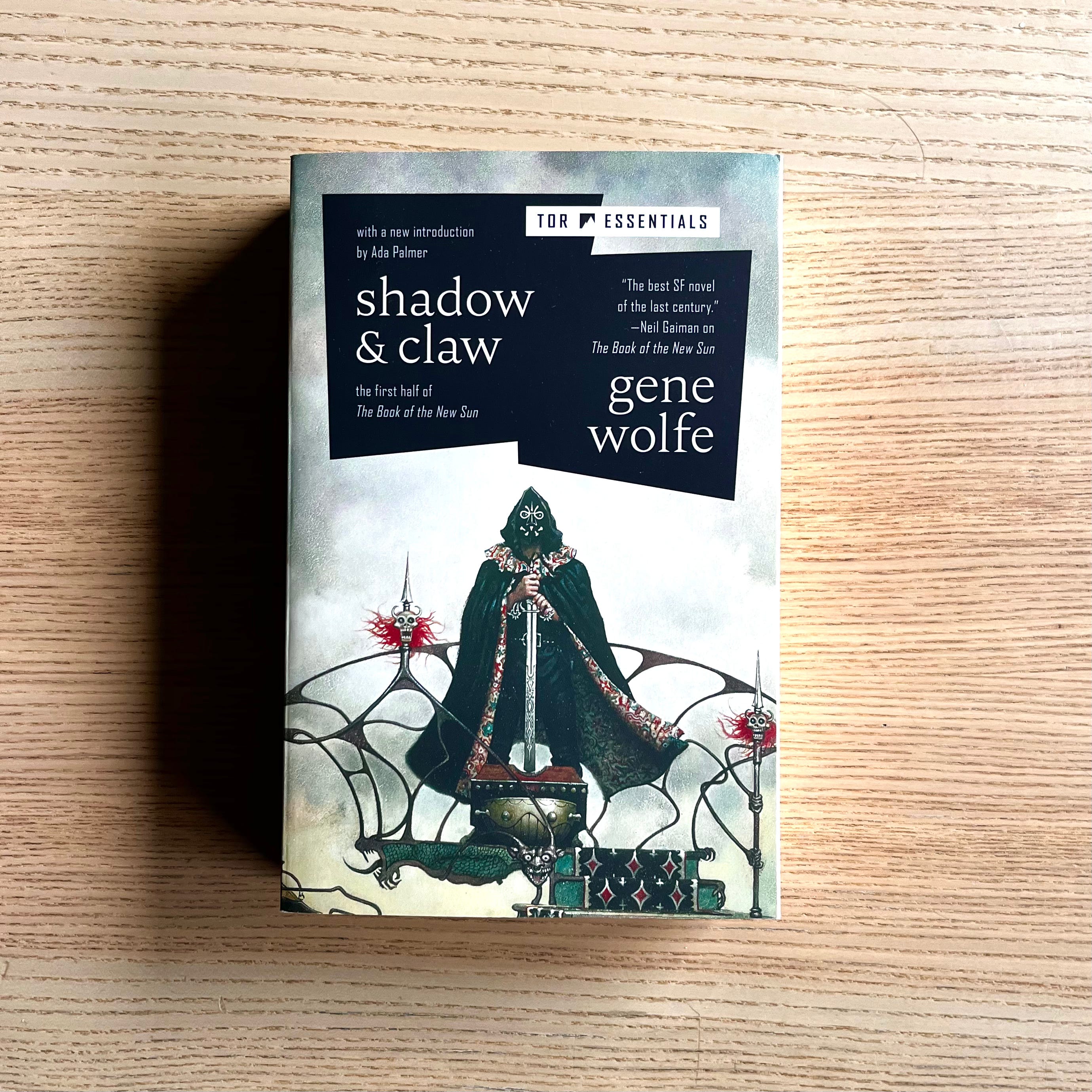
The Book of the New Sun (BotNS) is set in the evening of humanity. Urth is a shadow of its former self. The sun is dying. The world is littered with artifacts of greater times. When Severian, an apprentice of the torturer’s guild, goes against his training and shows mercy to a prisoner, he is exiled. And thus begins his wayward path to the throne. BotNS falls into a category I’d called Mystical Science Fiction, into which I’d also put Dune, A Canticle for Leibowitz, and Hyperion. Dark, gothic, moody, evocative, mysterious.
The Book of the New Sun is one of the great accomplishments of English literature. Wolfe’s prose is intricate and gorgeous without becoming purple or baroque. Though it can be hard to decipher, there is a coherent story here, encased in a world that feels always like you could turn down a random street and discover ever more detail. It also manages to be philosophical and theological without becoming didactic or self-important. With or without the label “Science Fiction”, I’d put it toe to toe with any English language masterwork.
Then why not start with it? It’s a difficult book for a number of reasons that also make it excellent. Like reading Shakespeare, it can be confusing because our far future narrator doesn’t provide necessary context for readers from the 21st century. He refers to concepts that don’t yet exist, which Wolfe renders in repurposed archaic terms that you may struggle to find in a dictionary. The narrative is a puzzle-box that makes half-sense on the first read, basic sense on a second, and continues to reward successive revisiting.
But fear not, there is a secret to enjoying BotNS on your first read: Don’t try to understand it. Don’t read it with pencil in hand. Don’t look up every word you don’t know. Don’t reread the chapter twice to figure out what you missed. Let yourself be confused. Experience it impressionistically. The basic action will generally be clear. This isn’t Faulkner where you have to re-read a page three times just to figure out that Uncle Jimmy went to the general store. Keep moving forward and things will click into place. And if you plan to read it a second time (probably months or years later) I recommend picking up a copy of Lexicon Urthus, a valuable reading companion.
A note on publication: The “Book” of the New Sun was written as four books, which are now often collected in two volumes: Shadow & Claw, and Sword & Citadel. You can continue with Urth of the New Sun, an unplanned fifth volume that Wolfe wrote at the request of his publishers to spell out the events that follow BotNS, which were merely implied. I don’t enjoy it as much, but many Wolfe fans would argue it’s necessary.
Peace
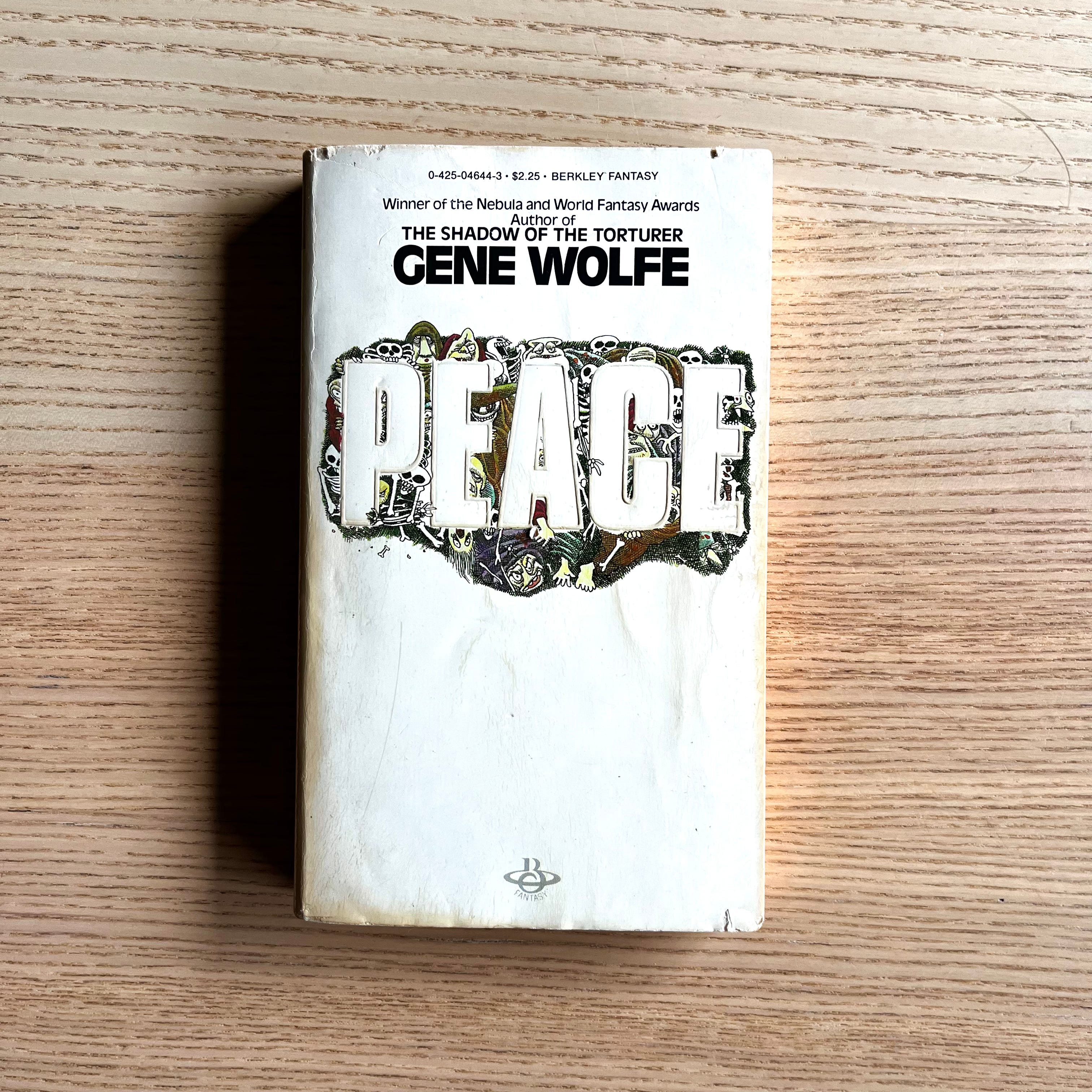
Peace is the memoir of a somewhat broken old man living alone in his very large home in the Midwest. He seems to have had a stroke and is no longer able to fully inhabit the house, so he wanders from room to room reminiscing about his life. The fantastic is woven all throughout this story, and yet you will struggle to definitively nail down any moment as supernatural. One has the sense that this is a ghost story, even if it’s hard to point to the ghost. If pressed, I’d label the genre not as “Horror” or “Fantasy”, but “Spooky”.
Peace is short, beautiful, and relatively accessible. It’s probably the second best place to start with Wolfe, but I think it is so quiet, so understated, that it’s easy to miss what kind of writer Wolfe is. Still, if it sounds more appealing than Fifth Head, go for it.
Latro in the Mist
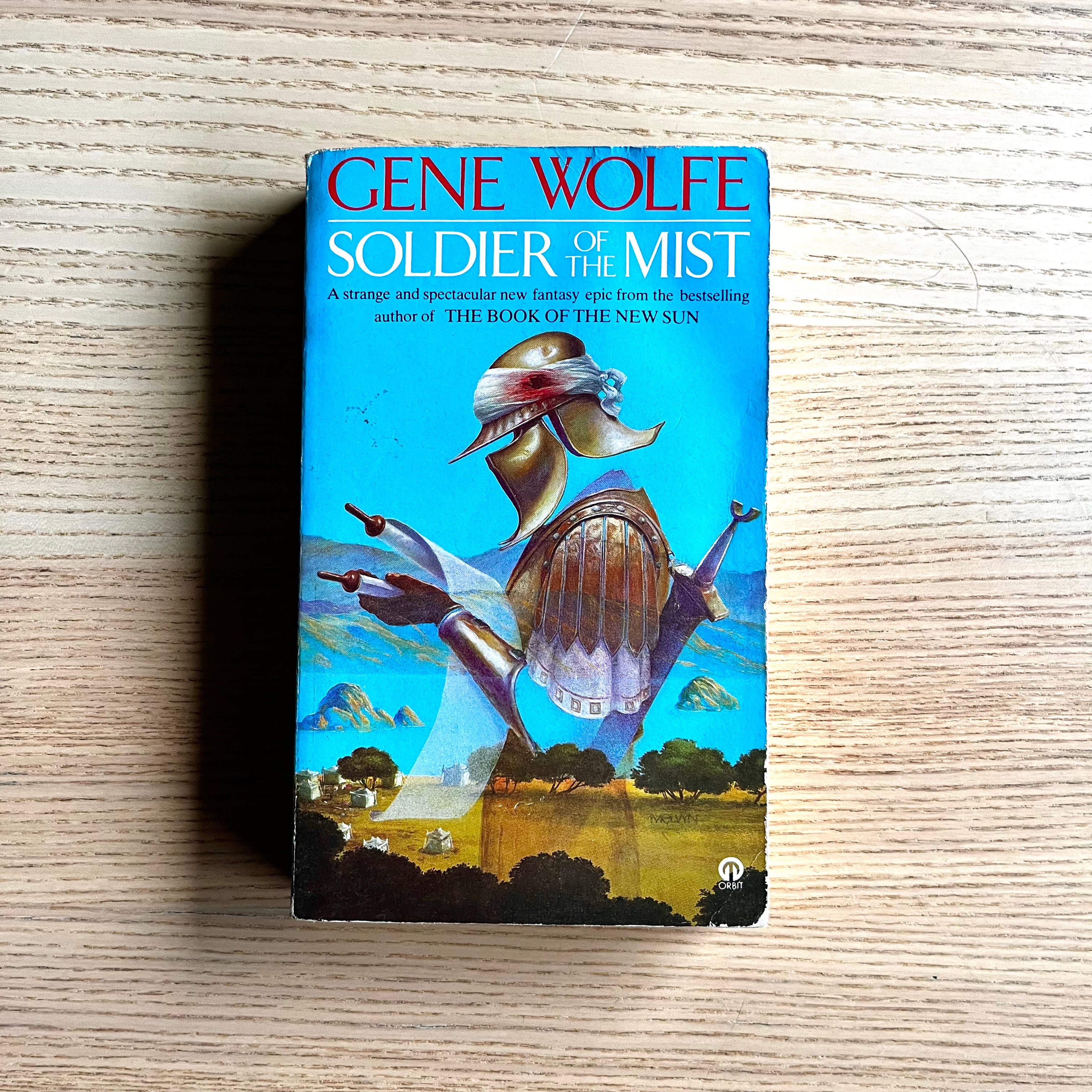
In Latro in the Mist the titular soldier, Latro, gets a head injury in a battle and from then on has retrograde and anterograde amnesia, giving him a rolling 24-hour window of memory. He writes to keep track of who he is and what he’s doing, which forms the text of the book. (Yes, it’s basically Memento, except this came first.)
Latro isn’t trying to lie to you, but like Severian, he doesn’t tell his story in a way that a modern reader would understand. He forgets to write things down, forgets to read what he writes, fails to recognize people he has met before or identify them clearly in the text. He is pushed this way and that, barely understanding what he’s doing or why. A lot of the fun is figuring out what Latro himself doesn’t know.
His injury also gives him a gift: the ability to see the Gods. Throughout his adventures, he is the pawn of deities and encounters mythic beasts. If you were a mythology kid in middle school and now have elevated taste in fantasy, I can’t think of a better recommendation.
Latro in the Mist is a volume of two books — Soldier in the Mist and Soldier of Arete. There’s also Soldier of Sidon, but I don’t like it as much and since there isn’t any strong resolution to the narrative, you could just as easily stop with Latro/Arete.
The Best of Gene Wolfe
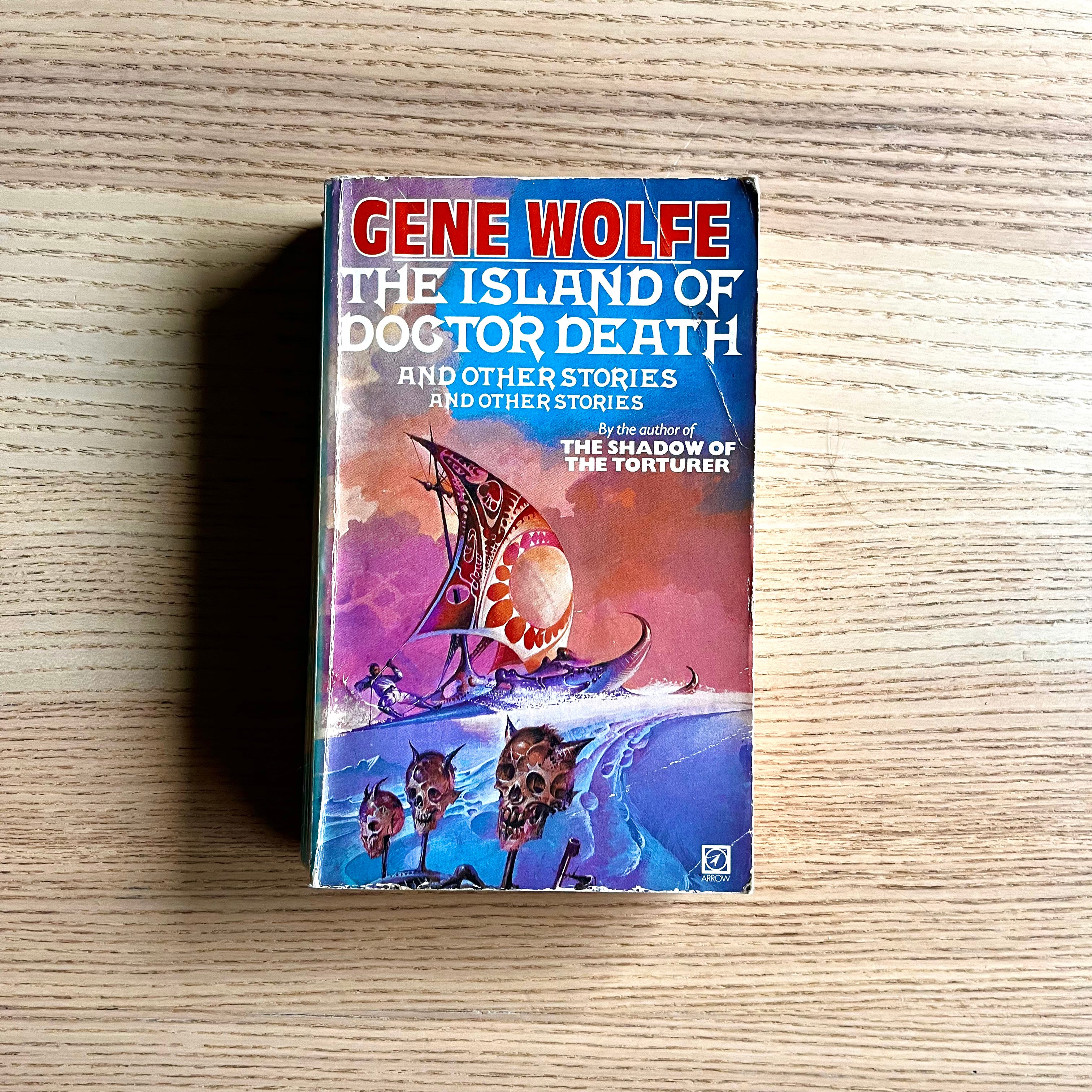
Wolfe somehow managed to have a prolific short story career in tandem with his prolific novel career. (It’s just not fair.) If you don’t want commit to a full-blown puzzle-box series, maybe you’d prefer to micro-dose.
In The Best of Gene Wolfe, Wolfe picked his own best work from his entire career and provided just a bit of commentary on them afterward (which often fundamentally changed how I understood the story). The subject matter includes neighborly aliens, kindly archvillains, gods who might not be gods, robots, ghosts, faerie, pirates, faerie pirates… I have several of his other collections, but the title of this one is accurate.
Some of my favorite stories include:
The Island of Doctor Death and Other Stories, about a boy escaping his life into a dime store paperback
The Death of Dr. Island (yes, really), about a sentient psycho-therapist island in space
La Befana, about Christmas in space
Forlesen, about how much he hated work
The God and His Man, about what it says on the tin
Death of the Island Doctor (yes, really), about a kindly old professor who loves islands
Parkroads — A review, about a highly abstract film that doesn’t exist but should
A Cabin on the Coast, about the aforementioned faerie pirates
3. Going deeper
“My definition of good literature is that which can be read by an educated reader, and reread with increased pleasure.”
— Gene Wolfe
Now is a good time to tell you about one of the best things about reading Gene Wolfe: re-reading him. Most of his books feel completely different the second time around. You know this experience from re-watching movies with a twist, like Fight Club, except that Wolfe layers his mysteries so that even a third or fourth reading will have you wondering at new questions.
At this point in your journey, re-reading any Wolfe work can be as valuable as picking up a new one. However, if you want to keep exploring, here’s where you can go next:
If you loved The Book of the New Sun and want more in that Universe, jump to: The Book of the Long Sun / The Book of the Short Sun
If you want Arthurian fantasy, a world with knightly chivalry but without its religious underpinnings, jump to: The Wizard Knight
If you want a inter-dimensional portal fantasy, jump to: There Are Doors
Book of the Long Sun / The Book of the Short Sun
If you loved The Book of the New Sun, Wolfe wrote two sequel series that I think you’ll enjoy as well.
The Book of the Long Sun tells the story of Patera Silk, a priest who is granted enlightenment by a god in the very first sentence of the book. Silk lives in the Whorl, a world on the inside of a massive egg-shaped asteroid with a beam of light stretching across the center. Yes, there are cities in the sky. (The denizens of the Whorl do not know that it is an asteroid, of course.) Silk is sent by this god, the Outsider, to save his parish, but that single moment of divine intervention creates an avalanche of action that pushes through the entire Whorl and only gets faster and bigger as the story progresses. (Keep that in mind when 80% of the first book is Silk trying to break into a house.) The narrative voice of Long Sun is the more familiar omniscient third, but that should make you suspicious because Wolfe doesn’t really do objective narration.
The Book of the Short Sun directly follows Long Sun, and there are some who argue that it’s his finest work. Horn, a character from Long Sun who now lives on a planet called Blue, sets out to find Patera Silk many years later. That sounds fairly straightforward, but the narrator begins recounting the tale when he is halfway home, so that telling of the first half of the journey overlaps with the action of the second.
Short Sun is written in an exceptionally intimate voice. The narrator is trying to grapple with his own guilt, his own identity, with his confused understanding of the events he’s partaking in, and we get this in the form of his journal entries, his piecemeal attempts at making sense of his own life to himself. He doesn’t have a head injury or a brain aneurysm, but Wolfe shows that even those of us without cognitive strangeness struggle to form tidy narratives. Some Gene Wolfe fans argue that Short Sun is his true masterwork.
The Wizard Knight
If Arthurian fantasy is your thing, The Wizard Knight is for you. A ten-year-old boy is transported to a fantasy realm and given the body of a full-grown, exceptionally strong man. He battles demons, dragons, trolls, and the like, but the description of that action is often something like “And then I hit them with my sword really hard.” Because again: he’s a ten-year-old boy.
Personally, I don’t think The Wizard Knight is Wolfe’s finest work (which still puts it head and shoulders above most fantasy), but I also know that there are many people who disagree with me. I was really taken aback when I encountered my first fellow Gene Wolfe fan in the wild and he said he hadn’t read The Book of the New Sun but worshiped The Wizard Knight.
Aside from being poetic, mystical, and brilliant, Wolfe had a wicked sense of humor. Wizard Knight contains my favorite joke of his: the main character occasionally tries to say to someone, “Hey, I’m just a kid in a man’s body,” to which other characters reply, “Man, I feel that”.
There Are Doors
There Are Doors is the first book on this list that I haven’t read, but as far as I can tell, it belongs at least this high on the list if not higher. In it, a completely unremarkable man, Mr. Green, follows his mysterious girlfriend Lara through doorways between parallel worlds and finds himself in a place where men die after sex and women rule through a goddess-worshipping culture. Obviously, it’s an oversight on my part that I haven’t read this and I plan to correct it immediately.
4. For completionists
From about 1970 to 2015, Gene Wolfe put out a new book roughly every 18 months. That’s just insane. The majority are fantastic, but no author could hope to write that many books and still avoid putting out some duds. I’ll categorize this last tier into two parts: lesser works and bilge.
Lesser works
If you have read everything in tiers 1-3, you can give these a try. If you haven’t, I’m not sure I see the point.
Free Live Free - Four down-and-out people in Chicago get involved in a mystery involving time travel and a perpetually flying airship.
Castleview - Arthurian legends bleed into a small Illinois town.
A Borrowed Man / Interlibrary Loan - A “recloned” author of mystery fiction solves real mysteries in a dystopian future.
The Devil in a Forest - A medieval peasant’s coming-of-age tale, Christianity vs paganism.
Pandora, by Holly Hollander - A teen detective story that’s actually about family secrets and small-town dynamics.
Bilge
These are simply not worth it, not because they’re bad necessarily, but because there are too many good Wolfe books to bother with them.
Pirate Freedom — Pirates
An Evil Guest — Lovecraft noir
The Sorcerer’s House — Epistolary
Home Fires — Warfare time dilation romance
The Land Across — Kafka-esque
Operation: Ares — Bad
Conclusion
Thus ends this overview of Wolfe’s work. If you have a quibble, go tell it to r/genewolfe and leave me out of it!
A visual guide to reading Gene Wolfe
Very interesting stuff. I personally think evil guest, and its companion pieces “tree is my hat” and “memorare”, plus some other one I haven’t read yet, are very very good. They all seem to be about tombs, in the same way fifth head is all about twins killing each other and assuming their identities. I prefer that cycle to botns, though I haven’t finished the latter. Also ern smithe is good
good.
I'm actively re-reading the Wizard Knight! And I had started the Book of the New Sun again, but had to set down for a bit.
Any familiarity with Ada Palmer? I think she matches Wolfe in world building.