
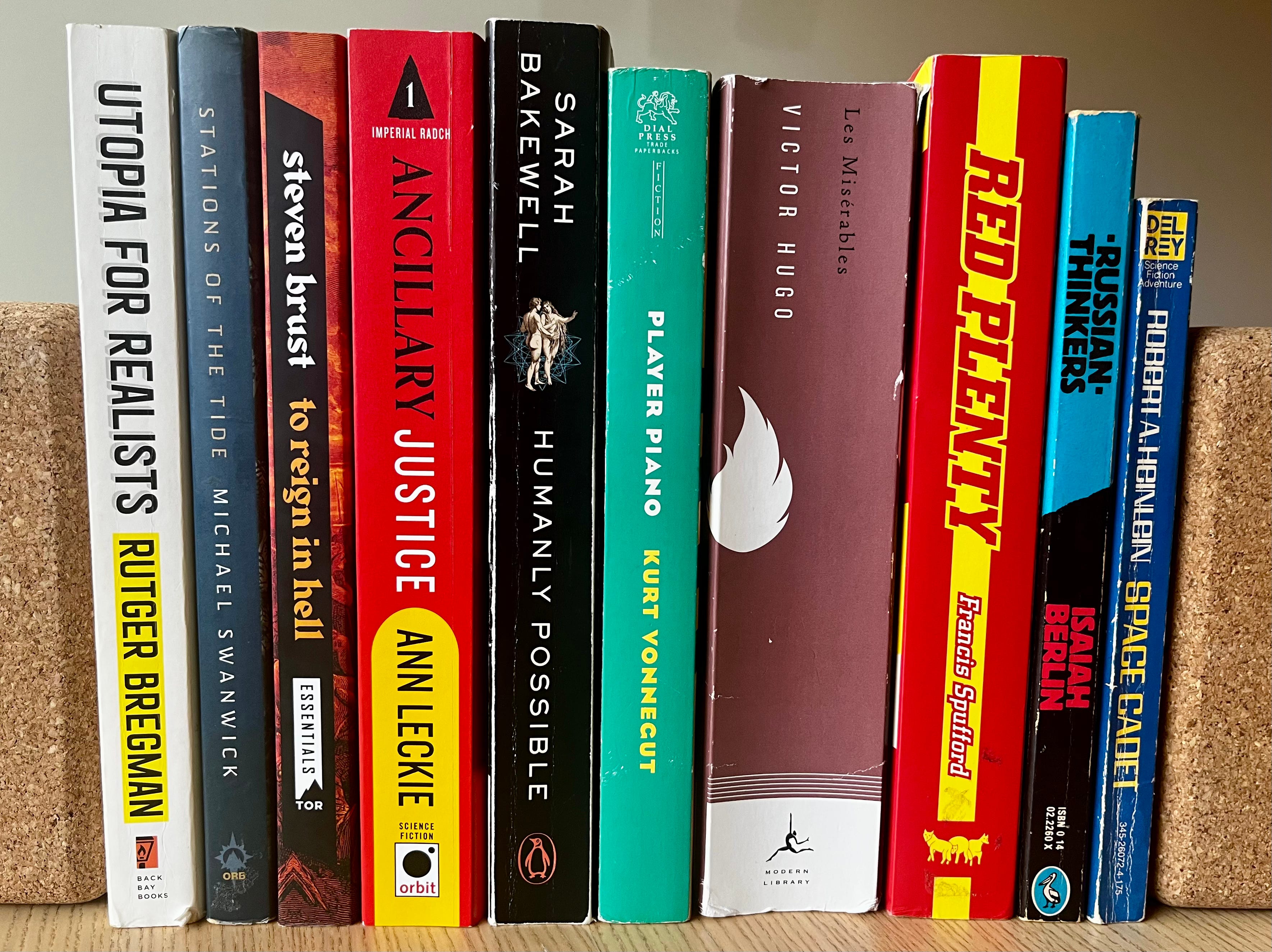
I was going to write a “best books I read in 2024” list, but my partner convinced me that I should write about the patterns in my reading instead. What resulted was much more interesting than a simple top-five list (though I love those too).
As I wrote this, it became clear how deeply interrelated my reading has been during the last year. Here, I’ve grouped the books by rough theme. These aren’t just reviews or summaries (though they’re partly that), but an attempt to find synthesis. I encourage you to jump around, follow threads, and see what captures your interest.
The scientist and society
As part of the novel I’m writing, I’ve become interested in the archetype of the mid-century scientist-intellectual. This person is a nexus of questions about science, technology, progress, and ideology.
Disturbing the Universe — Freeman Dyson (1979)
Freeman Dyson is perhaps the quintessential example of the mid-century scientist-intellectual. He worked in British bomber command in World War II (which he says “might have been invented by some mad sociologist as an example to exhibit as clearly as possible the evil aspects of science and technology”) and later with such names as Feynman, Oppenheimer, and von Neumann. He was involved in many great events of the nuclear era, including attempts to create the first commercial nuclear reactor (successful) and a nuclear-powered spaceship (unsuccessful). He worked on nuclear disarmament from within government and advocated against the nuclear test ban treaty (which he would later feel more ambivalent about).
In his memoir, Dyson grapples with the impact of science and technology. He had a front-row seat for the successes and failures of his field in this era — their instrumental (mis)use in the war, their complicity in creating weapons, their mixed attempts to create new tools and understanding. He talks explicitly about the Faustian impulse and comes down clearly that the way forward must always be about humanity, sympathy, and community. He echoes Terence:"I am human, and consider nothing human alien to me.”
“In everything we undertake, either on earth or in the sky, we have a choice of two styles, which I call the gray and the green... Factories are gray, gardens are green. Physics is gray, biology is green… Bureaucracy is gray, pioneer communities are green. Self-reproducing machines are gray, trees and children are green…"
J.D. Bernal: A Life in Science and Politics — Brenda Swann and Francis Aprahamian (2018)
Years ago, I learned about dazzle camouflage, a type of design used on some British ships during WWII as an attempt to confuse enemies. That’s when I first learned about J.D. Bernal, a scientist who led a team called the Department of Wild Talents to innovate strategies and tactics for Britain.
What really caught my attention was a quote I came across years later. "It is always the same way: I may be right, I may even know that I am right, but I am never sufficiently ruthless and effective to force other people to believe that I am right and to act accordingly." Bernal had worked on planning the landing at Normandy and he was lamenting that not all of his advice had been taken, perhaps because his scientific insight was perceived as abstract rather than practical. The despair in that line grabbed me.
Bernal, it turns out, was a complicated man. He was an Irish patriot that served Britain in the war. He was a scientist that was most at home with “poets, theologians, mystics, and rationalists.” He was a socialist that came to resent his fellow socialists and described their work as “plot”, “conspiracy”, and “cabal”.
And whereas Dyson seems to have an ambivalent but ultimately optimistic view of science and progress, Bernal feels much stronger conflict. He forecasted radical futures including space globes and disembodied brains. He predicted that humanity might split, with transhumanist scientists becoming star-exploring beings and “the meek shall inherit the Earth”, but he admitted that even felt a little revulsion about this possibility. He believed in an aristocracy of scientists and the impossibility of it ever coming to pass. He maintained optimism about science’s potential for human liberation even while suffering immense disappointment. He embodied both the promise and limitations of applying scientific rationalism to human affairs.
Dyson was exceptionally intelligent and influential, but he was also temperate and his success seems due to good-natured diligence. Bernal was a bit different; he was passionate, curious, clever, rational, and encyclopedic. As Voltaire might have put it, he had a bit of the devil in him.
The Romantic Machine — John Tresch (2012)
It is commonly held that scientists are strict rationalists and mechanizers, which makes Dyson and Bernal seem a bit odd for having some rather romantic views. Perhaps the stereotype is untrue, or maybe Dyson and Bernal make interesting subjects specifically because they embody this conflict.
However, it was not always thought that the two impulses were contradictory; scientists during the French Restoration thought of the two as not only compatible, but inextricably linked. For a time, they saw their work through a romantic lens; machines and industry were expressions of natural and divine order, the dichotomy between dreamers and realists was a false one. The period saw the development of steam engines, electromagnetic and geophysical instruments, early photography, mass-scale printing, fantastic literature, popular astronomy, grand opera, positivism, utopian socialism, and finally, the Revolution of 1848.

I can see why figures like Saint-Simon and Comte felt the need to merge these twin strands. As monarchical and religious authority fell and more secular, democratic forms tried to take their place, the pressure to maintain the strengths of the old systems must have been immense.
Central planning and mechanization
The mid-century Man of Science was sometimes/often engaged in the process of changing the state of things, either in their own thoughts or in practice. They knew from experience that material could be arranged differently to great effect, so why not society? The results were… mixed.
Player Piano — Kurt Vonnegut (1952)
I read Sirens of Titan in high school and found it sort of aggressively *fine*. I always considered Vonnegut to be a literary writer that used SF elements but didn’t really care about the genre. Jon Stewart mentioned Vonnegut at the end of his recent interview on Ezra Klein’s podcast, which lead me to revisit his bibliography. I was struck by the premise, which sounded a bit more properly Science Fictional than his other work (and thus, to me, more interesting).
The story follows Paul Proteus, the manager of an almost-fully-automated industrial plant in up-state New York. Proteus is an engineer, a believer in the faith of mechanization, but there is something gnawing at him. His life is materially rich but spiritually empty, and his unease with the non-engineer populous tells him that something here must be wrong. Those who don’t have one of the few technical professions, or one that can’t yet be mechanized, work in the Reconstruction and Reclamation Corps — useless time-killing jobs, like 40 guys filling a single pothole — or the military. Industry and bureaucracy have interlocked to make a society where people are given basic food, and housing, and appliances, but nothing much more can be had.
Red Plenty — Francis Spufford (2010)
I read this in 2022, but couldn't exclude it from this synthesis. Whatever else you might say about them, in the mid-century, the United States and capitalism made cheap hamburgers and good cars and all sorts of solutions to modern living. The U.S.S.R. knew that for communism to survive and thrive, they needed to beat the U.S. at their own game. This meant not just feeding everyone, but also making yesterday’s luxuries common and affordable. They needed to make a Soviet champagne. They needed a red plenty.
Their answer was to cyberneticize their economy. They bet that scientific planning and optimization could outperform the chaos of capitalist markets. Mathematicians tried to model and optimize the operation of their society through linear programming and early computer technology, economists tried to implement the models, and ordinary people lived with the results.
I find that the story of the U.S.S.R. is usually told as basically “Stalin tried to do communism by killing a bunch of his own people and the whole scheme was barbaric and stupid from top to bottom”. That, obviously, is a bad story. This tells a better one.
Pulp, adventure, and gee-whiz
Storytelling is an immense part of how we imagine our past, our future, ourselves, what’s good and bad, right and wrong, and SF has been one of the great shaping myths of the past century. In order to understand the behaviors and forces of the mid-century, I felt I needed to read what they had been reading a short time before and explore SF’s not-quite-SF roots.
Doc Savage, the Man of Bronze — Lester Dent (1933)
Before there was the Man of Steel, there was the Man of Bronze. First published in 1933, the character introduced a ground-breaking concept: what if there was a guy that was good at everything? A scientist, a fighter, an adventurer, a scholar, and it’s insinuated, a lover (though he comes across vaguely ace). Doc Savage is the prototype for the modern version of the “competent man” (an idea as old as myth; see: Odysseus).
Did I learn anything? The formula of the specialized team that encounters a mystery, uses scientific investigation, and comes to a rational explanation is, again, basically Star Trek. Savage was more renaissance man than I anticipated, and I saw more James Bond and Indiana Jones than meathead action hero. I think the cover illustrations led me to expect something more like Jack Reacher. Of course, Savage really isn’t big on emotional or moral complexity; this is clear-cut good and evil stuff.
Tom Swift and His Motor-Cycle — Victor Appleton (1910)
Since I was a kid, I knew Tom Swift purely as a type of joke: “‘Hand me that knife,’ said Tom, sharply.” It turns out this comes from the cheesy, cheaply written stories about a very competent, adventurous boy. Like many of the stories I read from this era, it’s about being earnest, good-hearted, hard-working, industrious, and clever.
What I find so funny is the humble beginnings. The first story, published in 1910, is about Tom repairing a “motor-cycle” and using it to go on a countryside adventure, but later titles involve Tom Swift and his air glider, his war tank, his sky train, his ocean airport, his giant robot, his atomic Earth blaster, his sub-ocean geotron…
Galactic Patrol — E.E. Smith (1937)
A mentally and physically powerful organization of crime-fighting explorers that travels the Galaxy at FTL speeds. Published in 1937, it actually struck me as more modern than its publication date in terms of its ideas, but that is likely because there it is a mostly-forgotten progenitor of properties that have long outlived it, including both Star Trek and Green Lantern.
I’m curious what it means that so much of the Star Trek formulation is here, so many years before it first aired. I’m not sure I have any answers. Nothing is wholly original, but what is it about this structure that it has survived nearly a century? What even earlier predecessors am I missing?
Foundation — Isaac Asimov (1951)
This is a sociological story about the predicted fall of a galactic empire, and how one man named Hari Seldon, a psychohistorian, orchestrated events centuries in advance to speed the re-ascent of civilization. This is conveyed through a number of crises, decades apart, where only one path can be taken.
I’ve read a ton of Science Fiction, including most of the big names and titles and some other pretty obscure stuff, but somehow I’ve never gotten around to Foundation. Maybe it just felt so fundamental that I wasn’t even curious about it, and as something published in 1951, it is about as old an SF novel as I can find enjoyable.
Having read it, I wasn’t surprised by anything, I wasn’t wowed by any of the plot, characters, or prose, I didn’t even really enjoy the journey. But I’m glad I read it because it is a key part of the history of the genre. For example, it suddenly becomes clear that Dune’s Paul Atreides was a response; Herbert thinks predicting the future would be way weirder than punching in some figures on a calculator. Predicting and controlling the flow of future events is a long obsession for SF, and this is somewhere close to the core of that concern.
Space Cadet, Citizen of the Galaxy — Robert Heinlein (1948, 1957)
I’ve read the works of Heinlein’s that remain best-known: The Moon is a Harsh Mistress and Stranger in a Strange Land, which are both modern enough to be intelligible and sufficiently fresh to our minds. But these are Heinlein “juveniles” (what is now called YA), written in the 40s and 50s.
In Citizen, a boy on a faraway planet is sold at auction to a beggar, and so begins one of many tutelages in which he serves different masters and learns different skills. Ultimately, it is about the difficulty — or impossibility — of becoming free. Cadet is more straight-forward: published in 1948, 18 years before the first episode of Star Trek, this is very nearly the story of a class of Starfleet Academy graduates.
These books are mostly for and about boys coming into their own, and encourage certain virtues — curiosity, independence, cooperation, leadership, courage, competence, critical thinking. Call me old-fashioned, but aside from the obvious representational issues, I think these would still make good reads for young people, and it surprises me that I have never seen them on store shelves.
Hidden gems and “recent” stand-outs in SF
When it comes to fiction, I read some fantasy and some literature, but my heart so decidedly belongs to SF. Having read most of the undeniable classic works and authors of SF, most of what I read in any given year tends to fall into two categories: obscure older works and the well-regarded books that people are still talking about a few years after publication. That I read two books from 2022 is very unusual for me.
Stations of the Tide — Michael Swanwick (1991)
I’m a huge Gene Wolfe fan and I’d heard this was inspired by his book, The Fifth Head of Cerberus. I loved it, but I can see why it isn’t better known. It’s about a nameless bureaucrat mucking across a swamp planet, a representative of an unimaginably technological future society trudging around an incredibly low-tech backwater. It contains obviously fake magic and less-obviously real magic. But does anything supernatural actually happen, or is it all just sleight of hand? Stations doesn’t offer an easy marketing line, it refuses to come out and say what it’s really about, though it’s very clearly about something.
To Reign in Hell — Steven Brust (1984)
A retelling of the rebellion in Heaven. I’m a total sucker for that sort of thing. I knew within seconds of pulling it off the shelf that I was buying it (despite never having heard of it before) and I finished it within 72 hours of getting it home. I’ve always suspected that Satan’s case was understated, that surely there *was* something tyrannical about Yaweh (in this telling, only the first among angels), and this book spells it out in a way that makes perfect sense. The plot is wonderfully organic, almost entirely told in brief conversations between dozens of angels, giving it an evolution that feels completely inevitable.
Ancillary Justice — Ann Leckie (2013)
This book was pitched to me all wrong. “It’s a book about a ship-mind in a human body, and it does cool stuff with pronouns.” I’ve read a few books with that description. Cool, I guess.
No! It’s a story about a hive-mind! Justice of Toren is a battleship, a personnel carrier, and its own army, all in one. This allows Leckie to tell the story with the intimacy of first person and the broad perspective of third. The book has some complicated things to say about humanity, individuality, and consciousness, and it never sounds moralizing. And yes, the pronoun stuff truly is neat, not so much radical as it is innovative.
All that said, I’m not sure I’ll continue with the series. Breq the Individual is less interesting to me than Justice of Toren, and I don’t think we’ll ever see the latter again. After my frustrating experience with Leech (which abandons the most exciting parts of its premise after the first 1/3), I am very glad to have found a book about a hivemind that doesn’t find one of the hivemind’s drones to be inherently more interesting than the hivemind itself.
A Half-Built Garden (2022)
The people of Earth have had a difficult journey toward a healthier planet. Through network protocols, they have crafted systems of consensus that allow them to do the work of repairing their environment. Then aliens show up — glad to find humanity alive (their other attempts at first contact found only dead civilizations) and insistent that humanity come live in their post-planetary habitats. The primary protagonists represent the watershed networks and push back on leaving, but soon they are joined by representatives from nation-states and corporations, both of which lost most of their power over preceding decades and are looking to get it back.
I found this to be a really interesting take on a partially-constructed solarpunk future. The most potent idea in the book is the network protocols, which suggest a future in which power is mediated through human values. Through its constant, near-universal participation, it accomplishes a democracy more complete than anything before it. This alone was worth an entire novel.
I have some quibbles with the execution. I’m not sure an intelligent species would treat so narrowly with a single family of humans, I think some of the politics weren’t relevant to the core ideas and will age quite rapidly, and the most interesting / realistic / sympathetic human character — the harried representative from NASA who just got pulled off maternity leave — was relegated to the background.
This book most reminded me of the Xenogenesis trilogy by Octavia Butler. Joining into community with aliens species might necessarily mean mutating into something current humanity might not recognize.
The Mountain in the Sea — Ray Nayler (2022)
A leading marine biologist goes to an island in Vietnam to study a newly discovered species of intelligent octopus. She works with the only "conscious" android ever made, and the island is protected by a drone operator. Elsewhere, a hacker is hired to crack into an AI more complex than any other he has encountered. And thirdly, a kidnapped man is enslaved on a fully-automated fishing ship.
I was initially frustrated by what I perceived as insufficient focus on the octopus element. However, it soon becomes clear that the other plot lines are thematically related to the octopus element in that they are all exploring consciousness and exploitation. In the back half of the book, there are more attempts to understand and contact the octopus. Rather than opening with an octopus-hello, it ends with it.
I finished the book feeling that this was one of the better works of actual, proper SF that I'd read from the past decade. It really engages with ideas and a world in a way that I most value about SF.
Revolutionary ideology
It all goes back to the French Revolution, all of it.
Les Miserables — Victor Hugo (1862)
Having never read it or watched an adaptation before, I always thought of Les Miserables as a historical drama, an emotional period piece about poverty and cruelty and the scent of black powder. And it sort of is, but it’s also a grand moral narrative about progress, revolution, humanity, and society, filled with wit, verve, humor, and style.
There is so much I could say about this book, and also nothing at all that I can say that it doesn’t say better for itself. It isn’t merely a “classic” — meaning an old book that someone professed authority is Important for some reason or another — but a real work of staggering genius. It asks a lot of you and gives twice as much back. It’s a moral tale, a gripping adventure, a suspenseful drama, a collection of essays on human nature, and a history lesson.
“But let those who don’t want anything to do with the future think carefully. By saying no to progress, it is not the future they condemn, it is themselves. They give themselves a fatal disease when they inoculate themselves with the past. There is only one way to reject Tomorrow and that is to die.”
Russian Thinkers — Isaiah Berlin (1978)
A lot of my reading patterns can only be explained by the format: “If you give a mouse a cookie…” In this instance, “If you start reading about the age of technological optimism in the mid-1900s, you’ll need to read about the Soviet Union. If you read about the Soviet Union, you’ll need to read about the Russian Revolution. If you read about the Russian Revolution, you’ll need to read about the generation of intelligentsia that inspired it.”
Isaiah Berlin made a close study of this cohort. They were born into a society divided into just two categories: nobility and serfdom. The intelligentsia were a small set of people who were able to travel to get a Western education and came back radicalized, full of ideas that had limited reach and appeal in their society except to their immediate peers. Furthermore, they lacked Western Europe’s history of day-by-day ideological evolution and social struggle. As a result, they overdosed on novel philosophy, and their society’s reactive evolution and struggle was expressed as a (relatively) sudden, massive, messy burst.
Historically, these figures are treated with a kind of pity, but Berlin finds many things to admire. They were passionate about ideas — they embraced them, argued about them, contradicted themselves, and radically changed their minds. As such, they made an excellent laboratory for experimenting with political ideas, revealing their moral and intellectual appeal as well as their dangers and shortcomings.
And this leads into the real question that Berlin is grappling with, the one at the dark heart of the liberal project: "Are all absolute values ultimately compatible with one another, or is there no single final solution to the problem of how to live, no one objective and universal human ideal?"
Red Star — Alexander Bogdanov (1908)
What a weird old book. Published in 1908, it imagines a Russian revolutionary that visits a communist Mars. For its time, it is a creative achievement for its imagination of space travel and the workings of a completed communist society.
Bogdanov was himself a revolutionary and so likely intended to write something inspirational, but the story ultimately ends with the protagonist having to return to Earth after finding that even he, the most radical of humans, was not psychologically or constitutionally prepared to experience a communist society. It’s unclear to me, and to scholars generally, whether this was a conscious or unconscious expression of Bogdanov’s own misgivings. The result is an ambiguous utopia like The Dispossessed by Ursula LeGuin. This book would later inspired the Red Mars trilogy by Kim Stanley Robinson, itself a story about a quasi-communist Mars.
Utopian theory
Core to the premise of this newsletter is that Utopia is an idea that means much more than a grand scheme for society or a paradise fantasy; it is an attitude toward the future that changes our behavior in the present. This was long an implicit attitude of mine, an instinctual position, but in the last few years it has become an explicit understanding. (I must credit Ada Palmer’s Terra Ignota for this.)
Since then, I’ve tried to read texts that speak to this idea. Many are academic, and they range mostly from having great ideas and obscure prose to having bad ideas and obscure prose.
Utopianism: A Very Short Introduction — Lyman Tower Sargent (2010)
Of the theorists I’ve encountered, I like Lyman Tower Sargent best. In this introduction, he actually attempts to get at the fundamentals of utopian thought and provides structure and clarity. He outlines different utopian modes — literary utopias, utopian practice, and utopian social theory — and presents a useful description of what we’re actually doing: social dreaming. I’ve read his work in other contexts and find him cogent and sensible.
"All utopias ask questions. They ask whether or not the way we live could be improved and answer that it could."
Utopia for Realists — Rutger Bregman (2014)
This is mostly a book of socially progressive policy arguments from 2014, which have perhaps lost a step in the intervening years, but the conceptual shell around all of those proposals is the argument for a return to utopian thinking that still rings true today.
Bregman’s argument is this: In the last 200 years, “Billions of us are suddenly rich, well nourished, clean, safe, smart, healthy, and occasionally even beautiful.” This is amazing, previously unheard of, it is yesterday’s utopia come to pass. But now that we have abundance, the dream of Utopia has run out. The only place to go from here seems to be stagnation or descent. Bregman clarifies that he’s not talking about a totalitarian blueprint utopia, but the vague outline utopia. If we are to go forward, we need a new lodestar, a new dream.
“Without all those wide-eyed dreamers down through the ages, we would all still be poor, hungry, dirty, afraid, stupid, sick, and ugly. Without utopia, we are lost."
A Primer on Utopian Philosophy — Jonathan Greenaway (2024)
It’s unfortunate that this has such a similar title to the last one, especially because I feel that it’s inaccurate.
It’s basically a marketing pamphlet for reading Ernst Bloch, a Jewish-German Marxist philosopher who fled Nazi Germany, best known for his work The Principle of Hope. It’s an enormous, arcane work in three volumes that I someday hope to read (but it is also expensive and difficult to find).
Bloch says that hope is a fundamental aspect of human consciousness that allows us to see latent possibilities in the present (the “not-yet”). This isn’t mere abstraction or naive optimism; it’s rooted in our current reality. We live in “the darkness of the lived moment”, unable to access all of the possible paths forward until we engage practically with hope. Hope is not simple, easy, or naive. It is engaged, willful, agential.
I feel more positively about Bloch’s work than this pamphlet about it, which occasionally has a tone of contempt that I don’t think he shares and that I find a bit unbearable. Bloch sounds cool, his most passionate boosters sound tiresome.
Humanism and the human spirit
This might seem like the topic that is unlike the others, but it’s actually the one that binds them all together.
Humanly Possible — Sarah Bakewell (2023)
Humanism rejects tacit authority. Nothing is sacred, everything is up for debate, there are no great texts or prophets — secular or otherwise. So how, then, does one define Humanism?
Bakewell’s answer is to express Humanism through a biographical history of its practitioners, a tour of artists, writers, activists, scientists, and more. The truth of Humanism emerges from the commonalities of her subjects — freethinking (rejection of absolute authority), inquiry (commitment to questioning and learning), and hope (belief in human potential for betterment). But Humanism is as much defined by their commonalities as their differences — their attitudes toward religion, science, government, education, morality, and the right way to live. In other words, this isn’t just a history of Humanism, but a Humanist history of Humanism.
In part, it is also a history of anti-humanist traditions, both religious and secular, which emphasize human misery and failings and argue that human nature must be fundamentally altered or constrained by higher authority.
This might be the most important book I read this year because it can speak so thoroughly to everything else in this list, to this moment, and perhaps to every moment.
"Happiness is the only good. The time to be happy is now. The place to be happy is here. The way to be happy is to make others so.” — Robert Ingeroll
Watership Down — Richard Adams (1972)
I love this book. I just finished listening to it again in the car with my partner and it’s just as good the second time around. Though ostensibly about rabbits, it's one of the most deeply humanist works I've ever encountered. It celebrates courage, leadership, intuition, strength, trust, cooperation, and the general will to live. It is good for the soul.
Station Eleven — Emily St. John Mandel (2014)
I first read this years ago, but picked it up again this year. While most post-apocalyptic fiction focuses on the brutality of survival and suggests that humans are savageness hiding behind a veneer of civilization, Station Eleven celebrates art, music, Shakespeare, human connection. Much as humanists of the past traveled between abbeys, looking for ancient texts to restore the beauty of a bygone age, this book insists that the candle shall not go out, that we will go on. This time around, I appreciated the Star Trek references much more. “Survival is insufficient” — the heart of the book — is a line from Voyager.
Also, if you haven’t watched the HBO Max adaptation, you must. It is the rare adaptation that successfully expands on its source material.
In conclusion
I wish I could say that my reading was this thematic every year. Obviously, I was grappling with a very specific set of questions and interests, which led me down separate but connected paths, looping back around at times. Science, technology, progress, revolution, hope, optimism, rationality, romanticism, liberalism, humanism, utopianism. The lines between science fiction and non-fiction often blurred.
Many of the books could have been put into multiple categories. Red Plenty, Red Star, and Russian Thinkers make a Russian series, The Romantic Machine and Les Miserables make a French one. To Reign in Hell is about a revolution!
Unsurprising to me at least is that it all comes back to a fascination with human attempts to direct our own progress — the tension between planning and organic development, between scientific rationality and human values, between revolution and evolution.
Thanks for joining me in 2024. Subscribe to catch what's coming in 2025 — this publication will be back with a new name and a more ambitious schedule.
That's a very nice list, thank you for sharing. I agree with your opinion on all the fiction i've read, so i'll take your word for it and add the rest (and the non-fiction) to my TBR!